
Non-Stick Aluminum Cookware: Global B2B Sourcing, Coating Matrix Chemistries, and OEM Engineering Standards
An authoritative technical whitepaper for global commercial buyers, brand managers, and procurement officers. Unpacking metallurgical substrate selection, multi-layer PTFE vs. Sol-Gel ceramic coating mechanics, regulatory compliance (PFAS/REACH), and supply chain optimization from Prowa Kitchenware Industries.
1. Substrate Metallurgy: Structural Integrity & Thermodynamic Efficiency
In the commercial procurement of Non-Stick Aluminum Cookware, thermal management and mechanical deformation resistance depend entirely on the underlying aluminum alloy grade and fabrication technique. For professional importers and brand owners evaluating OEM suppliers, understanding the microstructural physics of the aluminum core is paramount.
Aluminum possesses a exceptionally high thermal conductivity rate of approximately $225 \text{ W/m}\cdot\text{K}$, making it vastly superior to unclad stainless steel ($15 \text{ W/m}\cdot\text{K}$) for heat distribution. However, unalloyed pure aluminum (such as 1050 grade) exhibits low tensile strength, rendering cookware prone to bottom warping under rapid thermal cycling or induction stress. Prowa Kitchenware Industries addresses this structural vulnerability by utilizing engineered A3003-H14 Manganese-Alloyed Aluminum and high-density die-cast alloys.
| Manufacturing Process | Substrate Thickness | Grain Structure & Density | Warp Resistance (Induction/Gas) | Recommended B2B Market Segment |
|---|---|---|---|---|
| Cold-Rolled Pressed | 1.8 mm – 3.0 mm | Directional grain, moderate porosity | Standard (upto 220°C thermal shock) | Mass Retail / Economy Private Label |
| Heavy Forged Aluminum | 3.5 mm – 5.0 mm | Refined micro-grain, low void density | High (upto 280°C thermal shock) | Mid-to-High Retail / Specialty Brands |
| High-Pressure Die-Cast | 4.5 mm – 7.0 mm (Varying wall) | Isotropic solid state, zero internal void | Maximum Structural Stability | Commercial Hospitality / Luxury OEM |
By cold-forging aluminum under hydraulic pressures exceeding 2,500 metric tons, the grain boundaries of the metal are compressed. This mechanical displacement eliminates internal air pockets, creating a dense base that ensures uniform heat migration across the entire surface pan, preventing hot-spot food scorching and maintaining flatness within a tolerance of $\le 0.3\%$ of the diameter under high-heat operation.
2. Non-Stick Coating Chemistries: Fluoropolymer PTFE vs. Sol-Gel Ceramics
The functional lifetime of commercial non-stick cookware is governed by the chemical architecture of its release layer. Modern procurement strategies require a clear distinction between traditional multi-layer fluoropolymer systems and emerging inorganic silica-based sol-gel ceramic formulations.
Fluoropolymer (PTFE) Matrix Systems: Premium multi-layer PTFE coatings consist of a primer layer containing polyethersulfone (PES) or polyamide-imide (PAI) binders engineered to adhere to the acid-etched aluminum metal substrate. Above the primer, mid-coats infused with microscopic silicon carbide (SiC), titanium oxide ($TiO_2$), or synthetic diamond particles create a scratch-resistant barrier. The top layer consists of high-molecular-weight PTFE providing low surface energy ($\approx 18-20 \text{ mN/m}$). Prowa’s multi-coat PTFE formulations are 100% PFOA, GenX, and APEO free, fully compliant with US FDA 21 CFR 175.300 and EU Regulation (EC) No 1935/2004.
Sol-Gel Ceramic Coating Chemistries: Derived from a liquid precursor of tetraethoxysilane (TEOS) that undergoes hydrolysis and condensation polymerisation, ceramic coatings form an inorganic, glass-like silicon dioxide ($SiO_2$) matrix. Sol-gel ceramic layers feature extreme surface hardness (up to 9H Pencil Hardness) and thermal tolerance exceeding $450^\circ\text{C}$ without thermal degradation. However, their thermodynamic contact angle deteriorates faster than PTFE under repeated oil degradation cycles.
Engineering Brief: Pre-Coating Substrate Preparation
Coating longevity is 70% dependent on interfacial bond strength. Prior to coating application, Prowa subjects raw aluminum shells to an automated 8-stage chemical degreasing, acid etching, and aluminum oxide ($Al_2O_3$) grit blasting process (Mesh size 60-80). This creates a targeted surface roughness ($Ra$) of $3.5 \mu m - 4.5 \mu m$, anchoring the ceramic or PTFE primer into mechanical interlocks that prevent blistering, peeling, or delamination during commercial dishing cycles.
3. Product Portfolio & Recommended B2B Sourcing Lines
To serve global distributors, department stores, and private label importers, Prowa Kitchenware maintains an expansive manufacturing matrix. Below are core non-stick aluminum cookware configurations produced at our certified manufacturing center in Sialkot, Pakistan.
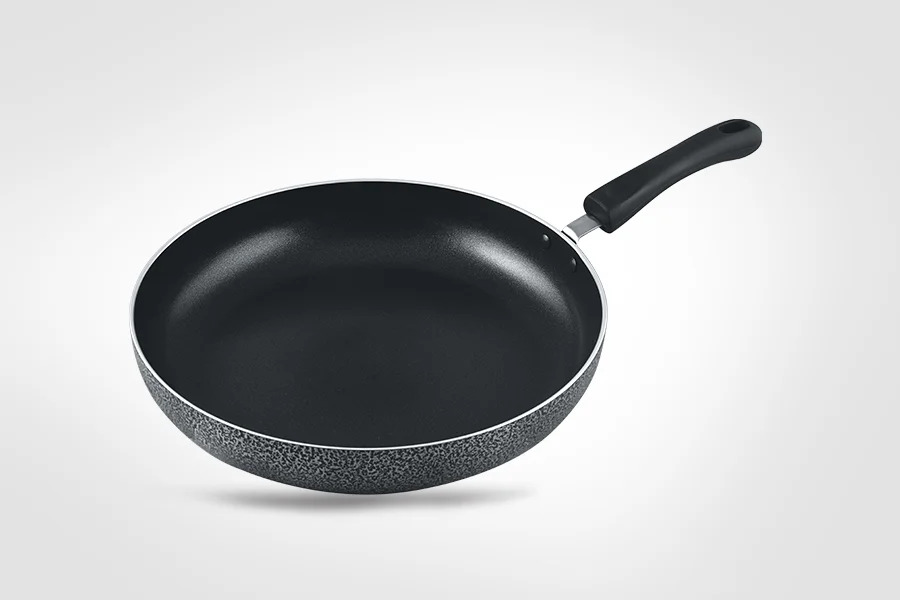
Forged Non-Stick Fry Pans
Heavy-gauge 4.0mm forged rim, 3-layer reinforced PTFE non-stick coating, soft-touch ergonomic Bakelite or riveted stainless steel handle. Compatible with induction hobs via impact-bonded AISI 430 stainless steel bottom plate.
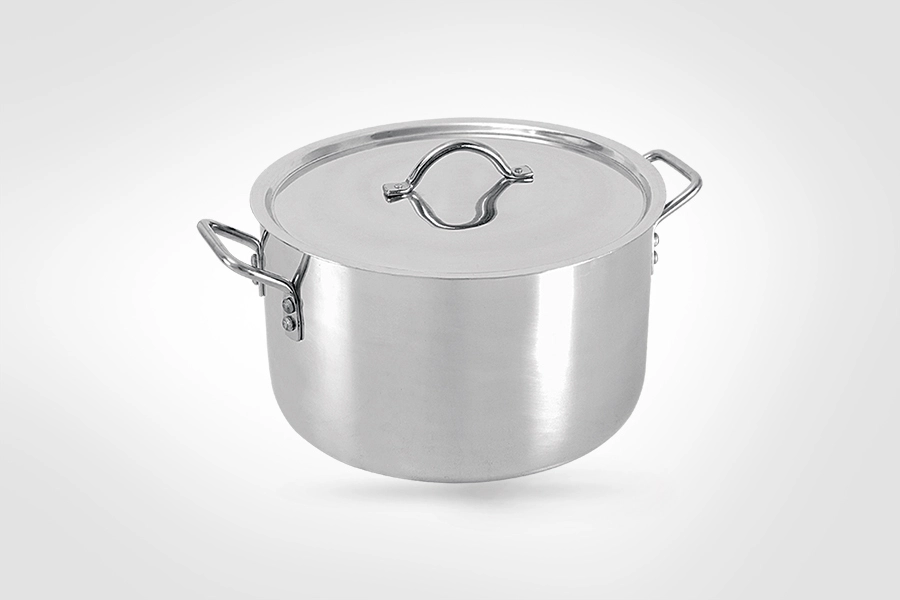
Non-Stick Aluminum Casserole Pots
Die-cast aluminum construction featuring integrated side handles for oven-safe versatility. Fitted with heat-tempered glass lids with silicone rims and dual-side steam vents. Available in 20cm to 32cm capacity ranges.
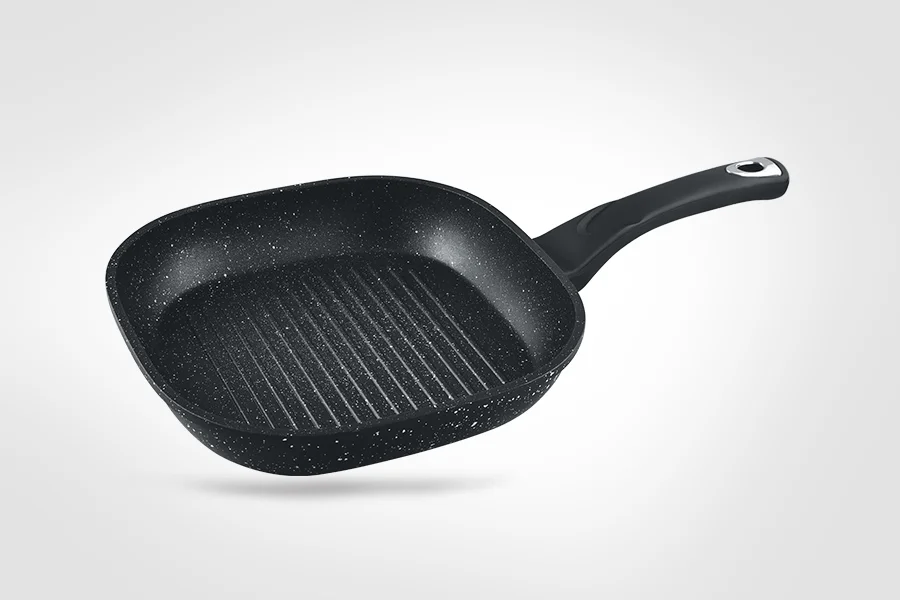
Diecast Non-Stick Grill Pans
Engineered with raised ridge channels ($2.5 \text{ mm}$ height) for authentic sear lines and oil drainage. Dual pour spouts and high thermal mass retention for commercial steak and protein preparation.
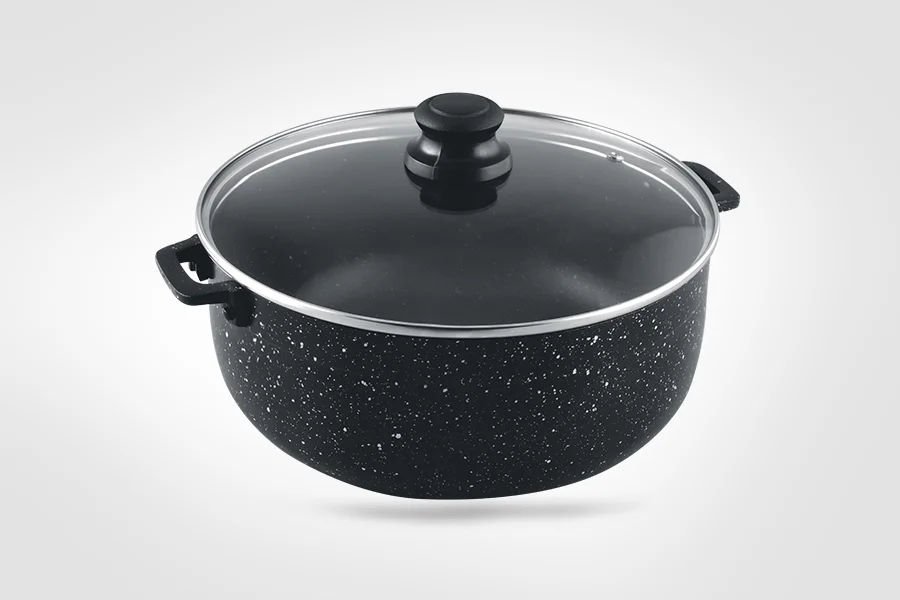
Traditional Aluminum Caldero Pots
Heavy-wall caldero vessels specialized for Latin American and international markets. Formulated with thick bases for slow-simmered rice, stews, and braises with non-stick or polished exterior options.
4. Future Global Sourcing & Industry Procurement Trends (2025–2030)
The global non-stick aluminum cookware market is experiencing structural realignments driven by regulatory tightening, sustainability imperatives, and geopolitical supply chain diversification. B2B procurement executives must structure their supply contracts to mitigate the following industry shifts:
A. Legislative Bans on Universal PFAS / Forever Chemicals
The European Chemicals Agency (ECHA) restriction proposal and legislative updates across North America (such as Minnesota's Amara's Law and Maine's PFAS regulations) are accelerating the phase-out of fluorinated polymers containing per- and polyfluoroalkyl substances (PFAS). Global brands are transitioning toward third-generation Sol-Gel ceramic non-stick surfaces and PTFE-free alternatives. Sourcing partners must verify that non-stick coatings are audited via Liquid Chromatography-Tandem Mass Spectrometry (LC-MS/MS) testing to prove total fluorine compliance.
B. Supply Chain De-Risking & South Asian Manufacturing Hubs
Over-reliance on single-region sourcing has exposed global brand owners to tariff volatility, rising labor costs, and freight disruptions. Sialkot, Pakistan, has emerged as a premier industrial center for stainless steel and aluminum metalworking. Facilities like Prowa Kitchenware offer cost-competitive manufacturing overheads, skilled metallurgical labor, direct access to international shipping lines, and favorable duty structures for Western importers.
C. Eco-Certified Recycled Aluminum Alloy Billets
Recycling scrap aluminum requires only 5% of the energy consumed during primary electrolytic smelting from bauxite ore, reducing carbon emissions by up to 95%. Major European and North American retail chains are enforcing mandates requiring cookware to contain a minimum of 75% to 100% certified post-consumer or post-industrial recycled aluminum (such as audited A3003 recycled ingot streams). Prowa integrates closed-loop aluminum scrap recycling across its stamping and trimming lines to support ESG-compliant supply chains.
D. Digital Product Passports & Traceability via Data Matrix Barcoding
In compliance with upcoming EU Digital Product Passport (DPP) regulations, industrial buyers require transparent traceability down to the raw melt batch. Prowa’s proprietary Data Matrix Barcoding technology permanently laser-engraved onto cookware bottoms stores critical supply data—including alloy melt chemistry, coating batch lot number, automated inspection logs, and date of manufacture—scannable throughout the product lifecycle.
5. Prowa Kitchenware Advantages, Quality Architecture & E-E-A-T
Operating from our state-of-the-art facility in Sialkot, Pakistan, Prowa Kitchenware Industries combines deep metallurgical heritage with modern automated manufacturing. Our corporate framework is built upon the core principles of E-E-A-T (Experience, Expertise, Authoritativeness, and Trustworthiness).
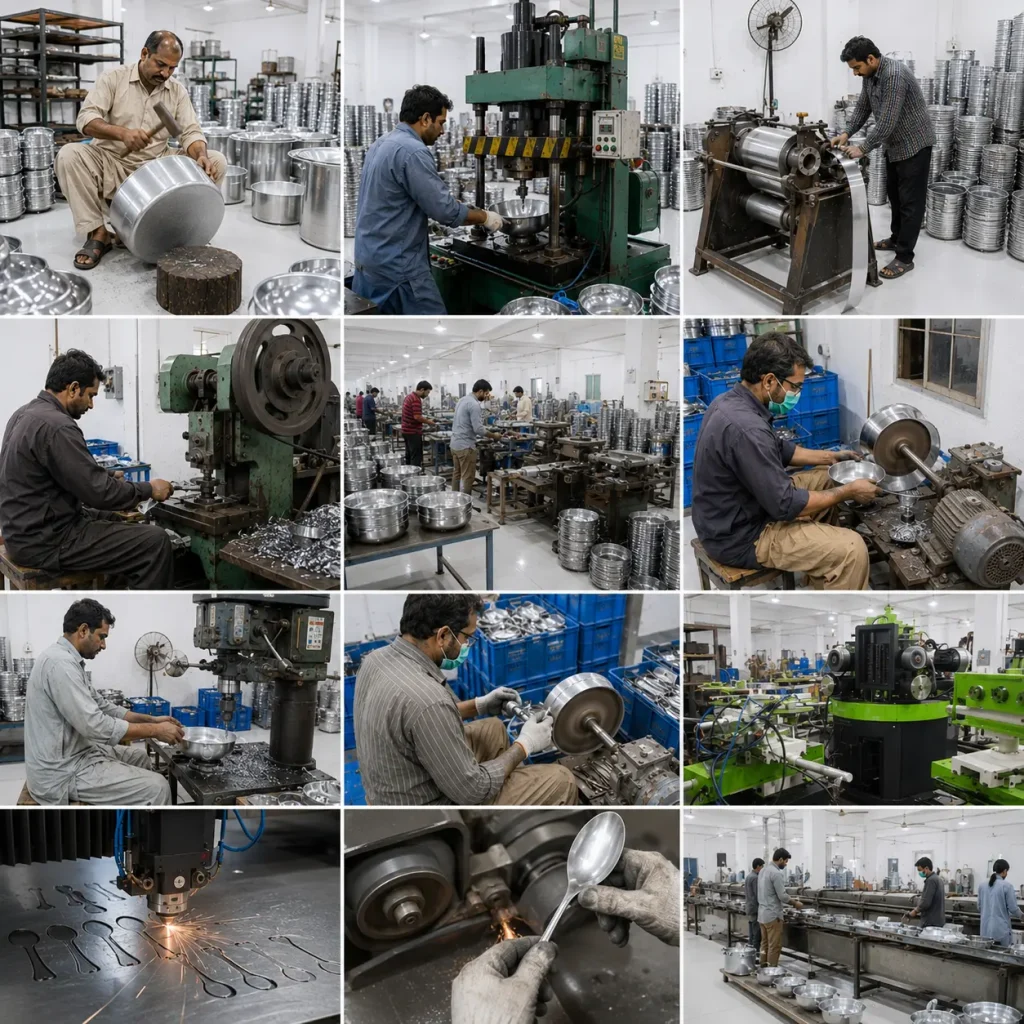
Fully Integrated Manufacturing Infrastructure
Unlike trading companies or fragmented assemblers, Prowa executes every step of cookware production under a single quality control system:
- In-house molten aluminum casting and sheet rolling.
- High-tonnage hydraulic deep-drawing and cold forging.
- Automated surface sandblasting & multi-station electrostatic spray lines.
- Laser-engraved Data Matrix marking & automated vision system inspection.
- CE, ISO 9001:2015, ISO 8442, ISO 15510, and GMP certified workflows.
Rigorous In-House Laboratory Testing Standards
Every batch of OEM cookware undergoes stringent laboratory verification prior to export container loading. Our quality assurance protocols conform to international standards:
- Cross-Hatch Adhesion Test (ASTM D3359 / ISO 2409): Precision lattice cutting on cured coating followed by pressure tape pull to ensure zero coating detachment (Rating 5B).
- LGA & MTP Mechanical Abrasion Resistance: Accelerated friction testing utilizing standard abrasive pads under continuous loading to verify resistance against metal utensils.
- Thermal Shock & Warpage Testing: Repeated heating to $250^\circ\text{C}$ followed by immediate quenching in $15^\circ\text{C}$ water to guarantee zero base deformation or micro-cracking.
- Corrosion Resistance (ASTM B117 Salt Spray Test): Continuous exposure to 5% salt fog for 48 to 168 hours to ensure complete immunity against acidic food pitting.
Frequently Asked Questions by Global Cookware Importers
Technical, regulatory, and commercial answers addressing common OEM/ODM buyer inquiries.
Ready to Elevate Your Non-Stick Cookware Line?
Partner directly with a certified manufacturer. Request technical specifications, custom OEM pricing matrixes, and physical product samples delivered to your corporate office.