
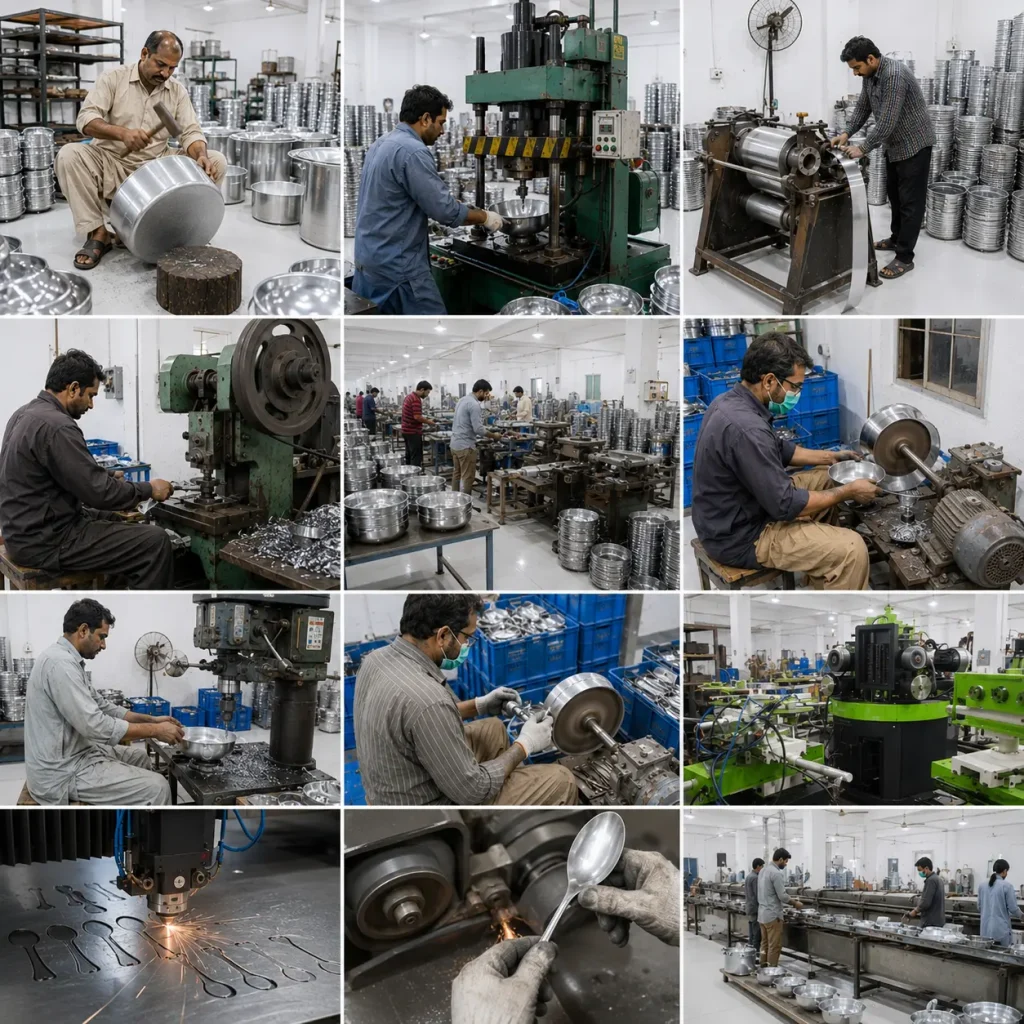
Manufacturing Insights
Material Selection & Metallurgical Standards
The foundation of high-performance commercial cookware lies in scientific raw material selection. Tensile strength, corrosion resistance, heat conduction, and structural stability during rapid thermal cycling dictate product longevity in high-intensity culinary environments.
18/8 Stainless Steel (AISI 304 Alloy)
18/8 stainless steel is the premier standard for professional cookware systems. Formulated with 18% chromium and 8% nickel, this austenitic alloy exhibits superior passive oxide self-healing characteristics, preventing pitting and chemical corrosion under acidic food contact. The nickel content preserves surface ductility and structural integrity, rendering cookware resistant to denting during high-volume operations.
Key Metallurgical Attributes:
- High resistance to organic acids, saline solutions, and industrial sanitation agents.
- Non-reactive food contact surface ensuring zero chemical leaching or metallic transfer.
- Maintains flatness and structural shape up to continuous operational temperatures of 800°C.
- Optimized grain structure suitable for ultra-smooth mirror polishing and satin brushing.
High-Purity Cookware Grade Aluminum
Aluminum is selected for its high thermal conductivity (approx. 237 W/m·K), transferring energy up to 15 times faster than standard stainless steel. Prowa utilizes high-grade aluminum billets across pressed, forged, and die-cast lines to ensure rapid preheating and elimination of localized heat spots.
| Material Specification | Thermal Conduction | Corrosion Resistance | Structural Weight | Primary B2B Application |
|---|---|---|---|---|
| 18/8 Stainless Steel (AISI 304) | 16 - 24 W/m·K | Maximum / Superior | Heavy Duty | Commercial Stock Pots, Gastronorm Containers, Chafing Dishes |
| Forged Aluminum Alloy | 200 - 220 W/m·K | High (Anodized / Coated) | Medium / Balanced | Professional Non-Stick Fry Pans, Chef Sauté Pans |
| Die-Cast Aluminum | 160 - 190 W/m·K | High (Heavy Wall) | Heavy Base | Thermal Retention Casseroles, Grill Pans, Dutch Ovens |
| Pressed Sheet Aluminum | 210 - 235 W/m·K | Standard Protective Coating | Lightweight | High-Volume Value Retail Cookware Lines |
Advanced Forming & Manufacturing Methods
Different forming technologies deliver tailored physical characteristics for specific market segments. Prowa integrates multi-stage hydraulic deep drawing, cold forging, and high-pressure die casting under one manufacturing infrastructure.
Hydraulic Deep Drawing
Utilizes precision-machined carbide dies under multi-ton hydraulic pressure to stretch sheet steel into seamless cylindrical cookware vessels. Eliminates lateral weld lines for superior hygiene and uniform wall thickness distribution.
High-Pressure Cold Forging
Solid aluminum blanks are compressed under 4,000+ tons of pressure. Re-aligns internal metal grain structure, densifying the metal to yield reinforced rims and ultra-thick bases that resist thermal distortion.
Precision Die Casting
Molten aluminum alloy is injected into hardened steel mold cavities at high speed and pressure. Allows complex structural integration such as side handles, variable wall thicknesses, and induction-ready base geometry.
Bottom Construction & Thermal Technologies
Multi-ply base engineering bridges the conductivity gap between stainless steel and aluminum. Prowa employs automated impact bonding to fuse distinct alloy layers into a unified thermal distribution engine.
Friction Impact Bonding
An inner heavy-gauge aluminum core disc is sandwiched between the stainless steel pot body and a protective magnetic stainless steel outer cap. Heated to near-melting temperature, a high-impact press stroke (up to 2,500 tons) fuses the metals molecularly without air pockets.
Fully Encapsulated Base Design
The aluminum core is sealed around the entire bottom perimeter. Prevents exposure to corrosive dishwasher detergents, prevents delamination, and ensures hygienic operation in commercial kitchens.
Induction Compatibility Integration
By incorporating AISI 430 magnetic stainless steel base plates, cookware exhibits rapid magnetic response on commercial induction hobs, achieving up to 90% energy transfer efficiency.
Precision Fabrication & Automated Quality Assurance
Automated machinery and rigorous quality control protocols guarantee dimensional consistency, batch-to-batch precision, and full compliance with international food safety standards.
6-Stage Quality Assurance Pipeline:
- Raw Material Spectrometry: Chemical composition analysis verifying nickel, chromium, and alloy purity prior to production entry.
- In-Process Dimensional Inspection: Laser wall-thickness verification and rim roundness measurement after drawing/forging.
- Thermal Stress Testing: Cyclic thermal shock testing to guarantee base bonding integrity up to 400°C.
- Surface Finish Measurement: Surface roughness (Ra) verification ensuring mirror polish standards below 0.2 microns.
- Handle Attachment Shear Testing: Rivet and spot-weld destructive testing exceeding commercial load requirements.
- Pre-Shipment Compliance Audit: Final visual, dimensional, and packaging verification according to AQL 1.5/4.0 criteria.
Request Full Technical Specifications & OEM Catalog
Partner with an export-oriented manufacturer certified in ISO 9001, CE, ISO 8442, and REACH compliance. Explore private label options and custom engineering services.
Get Catalog