


Industry Insights & Manufacturing Blog
Explore expert technical guides, material standards, and global supply chain updates from Prowa Kitchenware Industries.
Industry Engineering Whitepaper: Commercial Supply Chain Resilience for NYC Hospitality
The New York metropolitan area represents one of the world's most demanding commercial foodservice and premium retail cookware ecosystems. From high-BTU gas range environments in Manhattan fine dining institutions to heavy-volume institutional caterers in Queens and fast-expanding restaurant chains across Brooklyn, culinary hardware is subjected to relentless thermal shock, mechanical abrasion, and aggressive sanitation cycles. This technical whitepaper evaluates how elite Chinese hard-anodized aluminum and tri-ply stainless steel cookware factories deliver advanced metallurgical performance, compliance with New York State environmental mandates (including PFAS/PFOA bans under ECL § 37-0209), and precision OEM engineering tailored for North American enterprise distributors.
Engineered Commercial Cookware Portfolio
Optimized for high-volume commercial kitchens and private-label brand deployment in the NY market. Featuring heavy-gauge bases, precision micro-structures, and certified food-contact safety profiles.

Induction Tri-Ply Honeycomb Non-Stick Skillet
Combines physical stainless steel laser-etched honeycomb ridges with a recessed hard-anodized base matrix. Ideal for high-turnover NYC sauté lines using metal utensils.
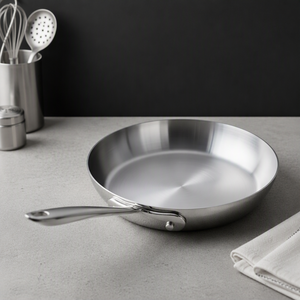
3.0mm Commercial Stainless Steel Fry Pan
Heavy-gauge 3.0mm wall construction built specifically for sustained high-BTU open flame usage in commercial steakhouse and bistro kitchens.

Professional 3-Layer Clad Honeycomb Pan
Full-clad 3-ply core providing edge-to-edge heat distribution. Eliminates scorching and hot-spots during delicate culinary reduction processes.

Multi-Ply Clad Commercial Cookware Set
Complete institutional culinary suite featuring cast stainless steel handles secured with double-heavy rivets for high-load durability.

22cm 18/8 Tri-Ply Skillet with Tempered Lid
Precision-balanced 22cm chef's pan featuring a sealed dripless pouring rim and heat-resistant hollow tube handle for effortless wrist operation.
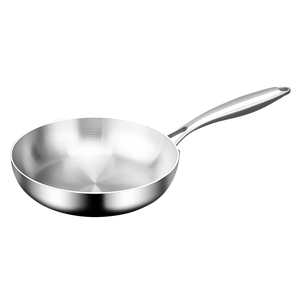
Eco-Clad 5-Ply 8-Inch Specialty Skillet
Advanced 5-ply construction integrating pure aluminum and alloy cores for instant thermal response and long equilibrium retention.

Round Honeycomb Non-Stick Executive Pan
Architectural micro-dot pattern elevates food above non-stick channels, reducing grease consumption while facilitating effortless releases.
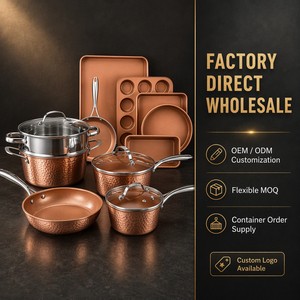
Hammered Copper-Aesthetic Tri-Ply Cookware
Combines classic aesthetic presentation for open-kitchen concepts in Manhattan with an induction-compatible hard-anodized interior layer.
Metallurgical Engineering: Type III Hardcoat Anodization
Understanding the chemical and structural transformations that elevate standard aluminum into commercial-grade Hard Anodized Cookware engineered for NYC restaurant standards.
Electrochemical Oxidation Mechanics
Hard anodization is an electrochemical process governed by MIL-A-8625 Type III specifications. Submerging high-grade AA3003 or AA1050 aluminum alloys into a low-temperature sulfuric acid bath (0°C to 5°C) with controlled direct current (DC) density converts the metallic aluminum surface into an integrated layer of Aluminum Oxide (Al₂O₃). Unlike applied coatings, this oxide layer is molecularly grown from the base substrate, preventing peeling, flaking, or delamination under high thermal stress.
Surface Hardness & Vickers Scale Performance
Standard raw aluminum yields a surface microhardness of roughly 30 to 50 HV on the Vickers scale. Chinese advanced anodizing facilities achieve an oxide layer thickness exceeding 40 to 50 microns (µm), driving surface microhardness ratings beyond 400 to 500 HV. This creates a surface twice as hard as AISI 304 stainless steel, rendering the pan scratch-resistant against metal spatulas, commercial scrubbing pads, and repeated stacking in commercial dish stations.
| Material Specification | Hard Anodized Aluminum (Type III) | Tri-Ply Stainless Steel (304/Al/430) | Cast Iron (Traditional) | Standard Non-Stick Aluminum |
|---|---|---|---|---|
| Surface Microhardness (HV) | 400 – 500 HV | 180 – 220 HV | 250 – 300 HV | 40 – 60 HV |
| Thermal Conductivity (W/m·K) | 210 – 235 W/m·K | 45 – 65 W/m·K (Core Dependent) | 52 W/m·K | 220 W/m·K |
| Abrasion Cycle Lifespan (ASTM D4060) | > 50,000 Cycles | > 100,000 Cycles | > 80,000 Cycles | 5,000 – 12,000 Cycles |
| Weight Density (g/cm³) | 2.73 g/cm³ (Ergonomic / Light) | 7.85 g/cm³ (Heavy) | 7.20 g/cm³ (Ultra Heavy) | 2.70 g/cm³ (Light) |
| Dishwasher Chemical Resistance | High (Anodized Sealed Porosity) | Maximum | Zero (Prone to Rust) | Moderate to Low |
Localized Application Scenarios across NYC Culinary Sectors
How specialized cookware design choices solve specific operational challenges across Manhattan, Brooklyn, and Queens commercial food enterprises.
Manhattan Fine Dining & Steakhouses
Manhattan commercial kitchens operate under compact square-footage constraints with high-BTU gas burners exceeding 30,000 BTUs per stove port. Hard anodized skillets with impact-bonded magnetic stainless steel bases prevent warp deformation caused by extreme heat differential when sear-tossing proteins. Sealed cool-touch tubular handles reduce wrist fatigue during 8-hour dinner services.
Brooklyn & Queens Ghost Kitchens
High-turnover delivery-only kitchens in Long Island City and Williamsburg rely on fast-wash cycle efficiency. Hybrid stainless steel honeycomb cookware allows kitchen operators to scrub vessels rapidly with wire mesh sponges without stripping non-stick performance, cutting dish-pit turnover cycles by up to 35%.
Long Island & NYC Institutional Caterers
Banquet facilities serving corporate events and weddings require large-capacity 5-ply stockpots and chafing dishes that maintain stable holding temperatures without burning sauces. Hard anodization provides lightweight ergonomics for kitchen staff transferring 40-quart vessels between preparation tables and warming racks.
NYC Regulatory Compliance & Procurement Trends
Navigating strict New York State legislation, environmental standards, and modern supply chain logistics for seamless import operations.
1. New York State PFAS / PFOA Elimination Mandate (ECL § 37-0209)
New York State has enacted stringent regulations banning intentionally added per- and polyfluoroalkyl substances (PFAS), including PFOA and PFOS, in cookware products offered for sale. Chinese tier-1 factories serving NYC importers utilize advanced Sol-Gel ceramic matrices or multi-layer inorganic silicon coatings completely free of fluorinated compounds, certified via LC-MS (Liquid Chromatography-Mass Spectrometry) testing by international agencies like SGS and TÜV Rheinland.
2. Port Newark Logistics & Freight Consolidation Optimization
Direct ocean vessel routing from East China ports (Ningbo-Zhoushan, Shanghai) to the Maher and APM Terminals at Port Newark / Elizabeth Marine Terminal requires robust ocean-freight packaging. Export cookware must be encased in 5-ply double-wall corrugated master cartons with moisture-barrier polyethylene liners and high-density corner guards to prevent rim crushing during transit across the Panama Canal.
3. Commercial Induction Conversion across NYC Hospitality
With New York City's Local Law 154 restricting fossil fuel gas hookups in new building constructions, commercial kitchens are rapidly converting to high-efficiency induction ranges. Modern hard anodized cookware exported to NYC incorporates a cold-friction-welded or impact-bonded AISI 430 stainless steel base plate (1.2mm to 2.0mm thickness), ensuring instant electromagnetic coupling and zero thermal warping under high-frequency induction fields.
Factory Core Competencies & Quality Infrastructure
How primary export manufacturing facilities enforce strict industrial quality control to ensure zero-defect B2B shipments.
100% Export-Oriented QA
Operating under ISO 9001:2015, ISO 14001, and CE certifications. Fully integrated manufacturing facilities execute rigorous metallurgical testing on raw sheet metal (spectrometric chemical composition analysis) to guarantee zero lead, cadmium, or heavy metal contamination.
Data Matrix Laser Engraving
Pioneering digital asset traceability by laser-marking every unit base with a permanent Data Matrix code. Importers and commercial inventory managers can instantly scan batch numbers, material grades, production timestamps, and quality inspector IDs.
Dual-Safety & Pressure Engineering
For commercial pressure cooking and heavy-duty stock vessels, integrated dual safety valves (rated for 12 PSI pressure vents) prevent structural failure. Heavy-duty cast handles undergo tensile pull testing exceeding 150 kg per rivet point.
NYC B2B Procurement & Sourcing FAQ
Direct answers to technical, logistical, and compliance inquiries from North American importers, restaurant supply catalog buyers, and OEM brand owners.
Q: Why choose Hard Anodized Aluminum over traditional Stainless Steel for NYC commercial kitchens?
While stainless steel offers excellent stain resistance, its poor thermal conductivity (16 W/m·K) leads to hotspots and pan scorching under heavy flame. Hard Anodized Aluminum combines superior thermal distribution (237 W/m·K) with an oxide surface layer rated over 400 HV—twice as hard as stainless steel. This provides rapid cooking speed, lightweight ergonomics for kitchen staff, and non-reactive cooking under acidic conditions.
Q: How do your cookware factories guarantee compliance with New York State PFAS/PFOA regulations?
We utilize 100% PFOA-free and PFAS-free surface technologies, including inorganic sol-gel ceramic non-stick linings and physical stainless micro-structure honeycomb guards. Every export batch bound for New York undergoes accredited third-party testing (SGS/TÜV) under FDA 21 CFR 175.300 standards, accompanied by full Certificates of Analysis (CoA) for seamless U.S. Customs clearance.
Q: What is the typical lead time for full container load (FCL) shipments to Port Newark?
Standard OEM production lead times range from 30 to 40 days following sample sign-off and deposit confirmation. Ocean transit time from Ningbo or Shanghai port via fast-water express routes directly to Port Newark / Elizabeth Marine Terminal typically requires 22 to 28 days, allowing NYC distributors to establish total procurement cycles under 60 days.
Q: Can we request custom handle tooling, laser-etched brand logos, and specific gauge thicknesses?
Yes. As a primary OEM/ODM manufacturer, we provide complete custom tooling services. Importers can specify aluminum gauge thickness (from 2.5mm to 5.0mm), interior coating formulations, custom silicone/cast stainless steel handle ergonomics, laser-engraved bottom brand logos, and custom retail packaging boxes.
Q: How does hard anodized cookware perform under commercial dishwashing conditions?
Type III hard anodization creates a dense micro-porous structure sealed at temperatures exceeding 95°C during production. This process seals the oxide coating, enabling the pan to withstand high-temperature commercial dishwashing cycles and high-alkaline detergents without chalking or surface degradation.
Q: What are the Minimum Order Quantities (MOQ) for private-label customization?
Our standard Minimum Order Quantity (MOQ) for customized hard anodized cookware is 1,000 units per size/model. For full catalog tri-ply cookware sets or consolidated container orders combining multiple SKU sizes, flexible MOQ terms start as low as 500 units per SKU.
Partner with China's Premier Hard Anodized Cookware Exporter
Accelerate your New York supply chain with direct factory pricing, certified regulatory compliance, and precision OEM manufacturing. Connect with our senior engineering team today.