


Industry Insights & Manufacturing Blog
Explore expert technical guides, material standards, and global supply chain updates from Prowa Kitchenware Industries.
Engineered Heavy-Duty Commercial Aluminum Cookware
Explore our export-grade aluminum cookware series engineered specifically for high-intensity restaurant lines, hotel catering operations, commercial bakeries, and industrial food service providers.
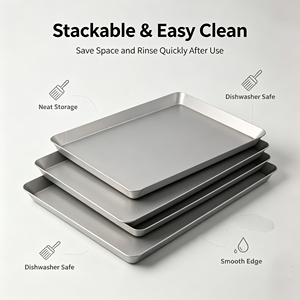
Commercial Aluminum Oven Tray Custom Size Baking Pan for Bakery Kitchen
- High-Strength 3003-H14 Sheet Aluminum
- Wire-Reinforced Anti-Warp Rim Edge
- Gastronorm (GN) & Custom Sizing
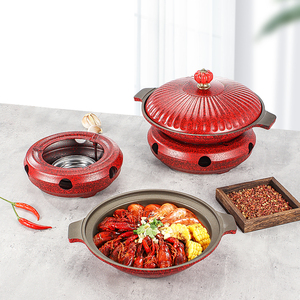
Commercial Aluminum Alloy Dry Cookware with Double Ears Alcohol Insulated Pot
- Cast Double Handles (Shear Load > 4.5kN)
- Alcohol/Burner Insulated Base Base
- High Thermal Retention for Dining Tables
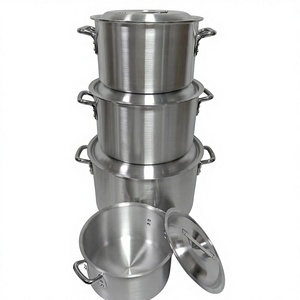
Heavy Duty Aluminum Stock Pot Set Extra Thick Cooking Casserole with Lid
- 4.0mm to 6.0mm Deep-Drawn Heavy Wall
- Quadruple Solid Aircraft-Grade Rivets
- Capacity Range: 12L to 80L Bulk Cooking
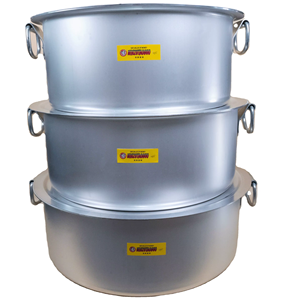
Large 3-Piece Aluminum Cookware Set Heavy Duty Commercial Cooking Pots
- Impact-Resistant Multi-Pots Bundle
- Ergonomic Stay-Cool Tubular Handles
- Precision Lids with Steam Escape Pressure Control
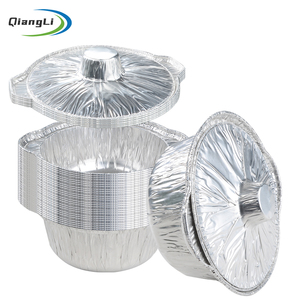
34oz/1000ml Food Grade Disposable Aluminum Foil Round Cooking Pots with Lid
- 8011-O Alloy High-Purity Aluminum Foil
- Thermal Tolerance: -40°C to +350°C
- 100% Recyclable Takeaway & Catering Solution
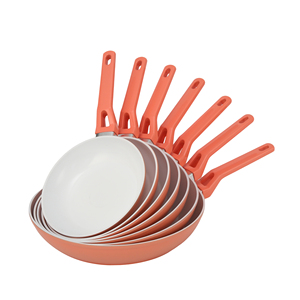
Commercial Deep Aluminum Frying Pan Non-Stick Marble Coating Induction Ready
- 3-Layer PFOA-Free Swiss Marble Coating
- Impact-Bonded AISI 430 Stainless Bottom
- 4.5mm Heavy Gauge Bottom Wall Ratio
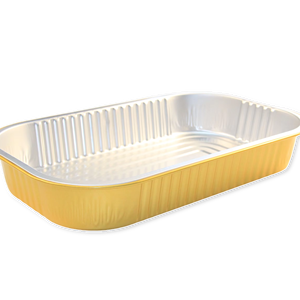
Rectangle Heavy-Gauge Catering Aluminum Foil Baking Pans GN Pan 1900ml
- Standard Gastronorm Modular Footprint
- Rigid Structural Corner Embossing
- Dual Lidding: Ovenable Foil or PP Snap Lids
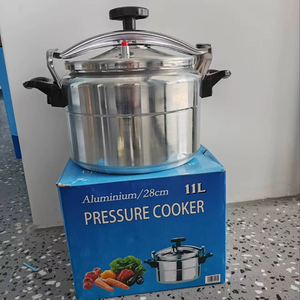
Heavy Duty 11L Commercial Aluminum Pressure Cooker Fast Boiling Pot
- High-Tensile Die-Cast Aluminum Body
- Dual Safety Valve + 12 PSI Vent System
- Heavy Clamp Lock with Food-Grade Silicone Seal
Technical Supremacy & Material Intelligence in Commercial Aluminum
Why leading global restaurant supply brands, hotel chains, and commercial importers source aluminum cookware engineered with targeted alloy chemistry and hard-anodization processes.
3003-H14 & 3004 Alloy Selection
Commercial kitchens subject pots and pans to relentless thermal cycling. We utilize refined manganese-aluminum alloys (Al-Mn 3003/3004) providing 20% higher yield strength than 1050 pure aluminum, preventing bottom sagging and rim buckling under intense gas burners.
Type III Hard-Anodized Protection
Our electro-chemical anodization converts aluminum surface layers into ultra-hard aluminum oxide (Al₂O₃ up to 50 microns deep). The resulting surface is twice as hard as stainless steel (Rockwell C 65), impervious to acidic food reactions, and scratch-resistant.
Safety & Compliance Engineering
100% non-toxic food contact assurance. All fluoropolymer non-stick systems are completely PFOA-free, PFOS-free, Lead-free, and Cadmium-free, rigorously tested to pass US FDA 21 CFR 175.300, European LFGB §31, and NSF/ANSI Standard 2 for food sanitation.
Comparative Technical Analysis: Commercial Cookware Materials
| Performance Parameter | Heavy-Gauge Aluminum (3004-H14) | Standard Commercial Stainless (304) | Cast Iron Cookware |
|---|---|---|---|
| Thermal Conductivity (W/m·K) | 215 W/m·K (Ultra-Fast) | 15 W/m·K (Slow / Hot Spots) | 52 W/m·K (Moderate) |
| Specific Gravity / Weight Efficiency | 2.70 g/cm³ (Lightweight / Low Fatigue) | 7.90 g/cm³ (Heavy) | 7.20 g/cm³ (Very Heavy) |
| Heat Distribution Uniformity | Superior Edge-to-Edge Thermal Flow | Requires Bonded Copper/Alu Core | Slow Latent Thermal Conduction |
| Commercial Kitchen Energy Saving | Up to 24% Gas/Power Reduction | Baseline Standard Energy Draw | High Initial Heat Preheating Load |
| Surface Hardness (Hard-Anodized) | Vickers Hv 400-500 (Rockwell C60+) | Vickers Hv 150-200 | Vickers Hv 120-180 |
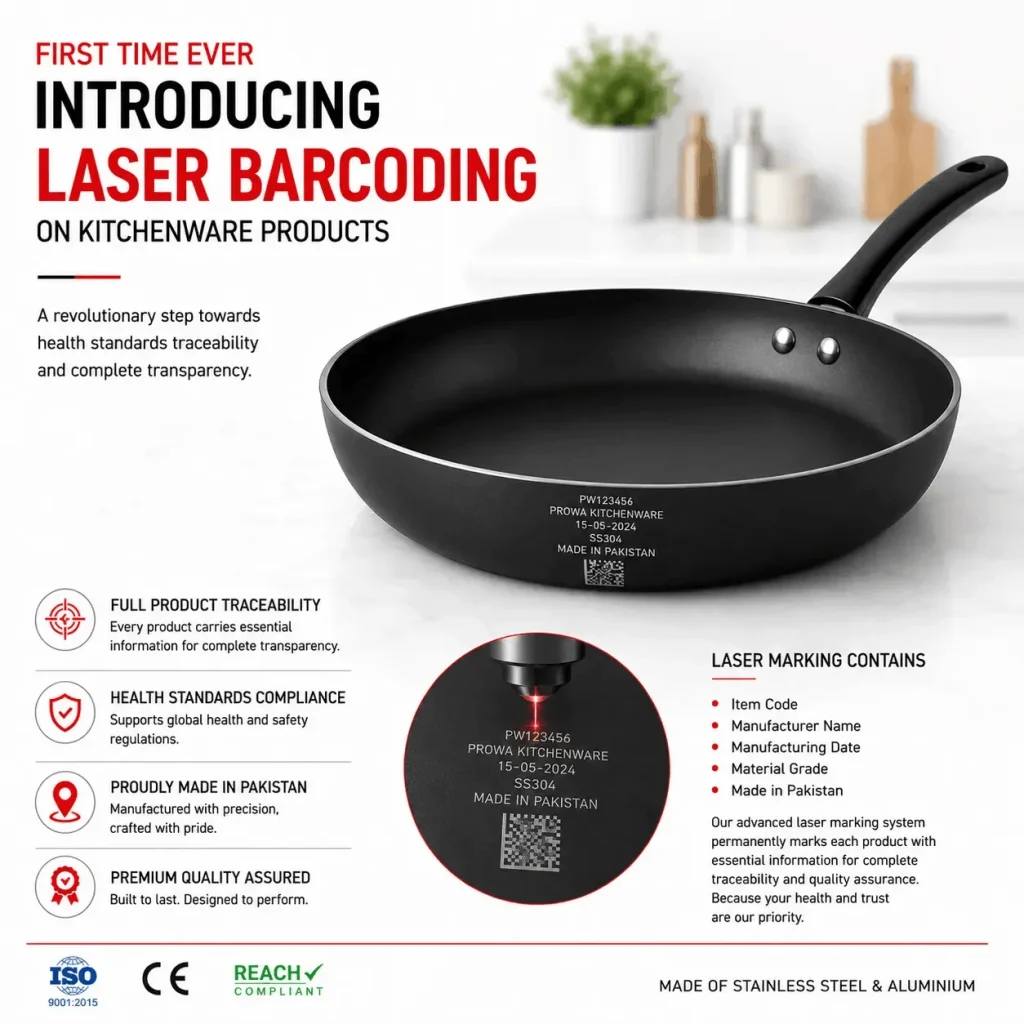
Laser Data Matrix Traceability & Digital QC Systems
In high-turnover hotel chains, institutional catering, and commercial food manufacturing plants, equipment asset tracking is paramount. Our China OEM manufacturing facilities implement high-precision Fiber Laser 2D Data Matrix Barcoding directly onto the structural aluminum rims or handle rivets.
Unlike temporary stickers or screen-printed labels that wear off in industrial dishwashers, laser engraving creates a permanent, tamper-resistant digital fingerprint storing:
- Exact Material Heat Batch & Chemical Composition Certificate
- Production Date, Stamping Press ID, & QC Inspector Code
- Custom Inventory SKU & Commercial Warranty Tracking ID
Future Procurement Trends in Commercial Aluminum Cookware
Key technological transformations shaping global hospitality supply chains, restaurant equipment distribution, and OEM manufacturing contracts over the next decade.
1. Impact-Bonded Induction Base Adoption
Commercial kitchens are rapidly shifting from gas ranges to high-efficiency induction cooktops to meet stringent zero-emission commercial building codes. Our advanced 2500-Ton Friction-Bonding Technology fuses a magnetic AISI 430 stainless steel disc onto the heavy aluminum bottom, ensuring zero air-gap thermal transmission and preventing disk delamination during extreme heat drops.
2. Nanocomposite Ceramic Non-Stick Coatings
With global chemical regulatory bodies (ECHA REACH and US EPA) tightening restrictions on PFAS fluoropolymers, future-proof procurement relies on multi-layer plasma ceramic matrix coatings. These silicon-based matrix structures provide ultra-smooth release without synthetic fluoropolymer compounds, standing up to harsh metal utensil contact.
3. Closed-Loop Recyclability & Low-Carbon Aluminum
Enterprise procurement departments now prioritize ESG scoring. Aluminum cookware manufacturing leverages 95% energy savings in secondary aluminum recycling compared to primary smelting. Our supply chain incorporates ISO 14021 certified recycled aluminum billets with verified low carbon intensity footprints.
Deep-Drawing Mechanics & Stress-Relief Annealing
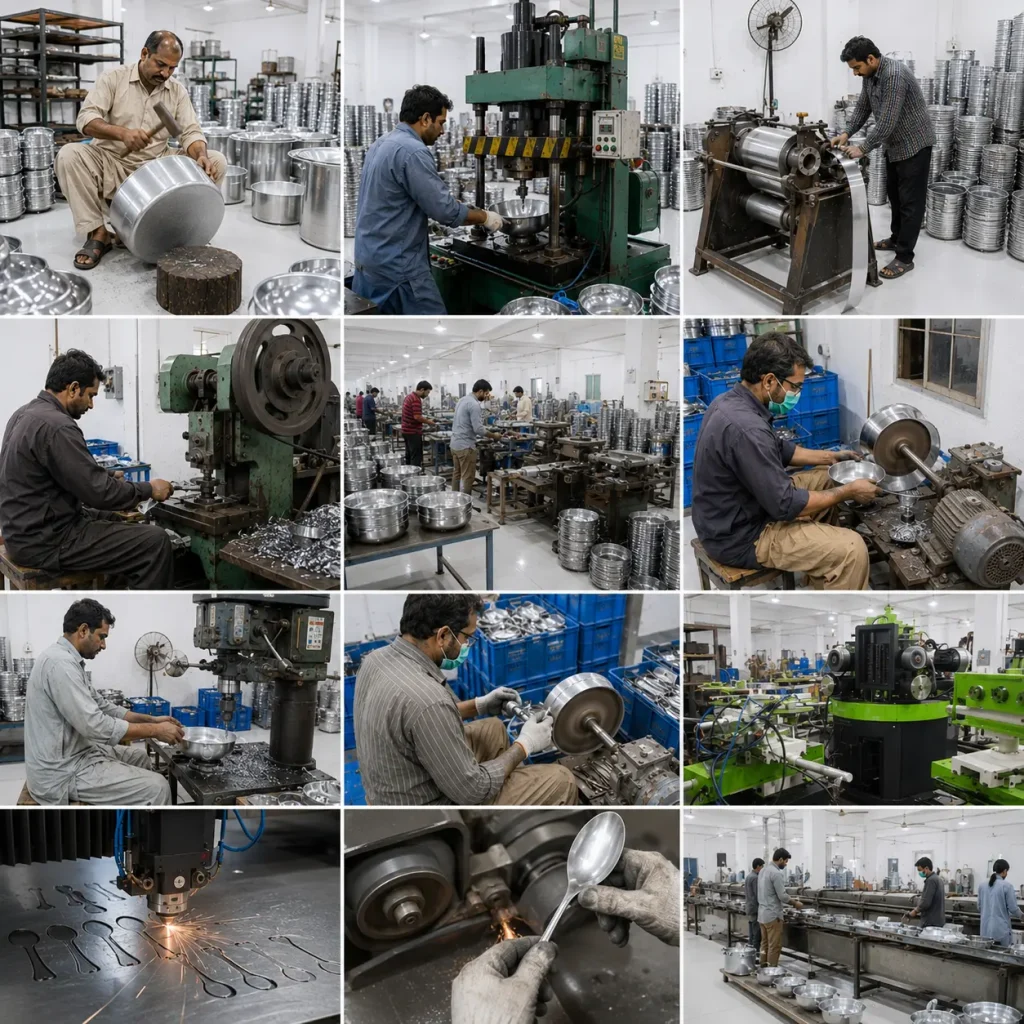
The structural integrity of heavy stock pots and pressure cookers depends on precise deep-drawing hydraulic pressure. Poorly drawn aluminum suffers from microscopic stress fractures along the bottom radius, leading to pinhole leaks after continuous thermal expansions.
Our Chinese manufacturing hubs utilize Finite Element Analysis (FEA) computer-simulated stamping paired with intermediate stress-relief annealing furnaces. This metallurgical heat treatment realigns the aluminum crystalline lattice, guaranteeing uniform wall thickness and eliminating internal metal fatigue.
Commercial Cookware Procurement FAQ
Technical, logistical, and compliance answers for global procurement directors, wholesale distributors, and restaurant supply chain managers.
What are the metallurgical differences between 3003, 3004, and 1050 aluminum alloys in commercial cooking applications?
1050 Aluminum is 99.5% pure aluminum offering exceptional thermal conductivity (230 W/m·K) but lower tensile strength, making it suitable mainly for light disposable containers or light bakeware. 3003 Alloy is alloyed with 1.0–1.5% Manganese, increasing mechanical strength by 20% while maintaining fast heat transfer—ideal for commercial baking trays and medium fry pans. 3004 Alloy adds Magnesium for even higher yield strength and deformation resistance under severe 24/7 commercial heating, making it the industry standard for thick-walled stock pots and pressure cookers.
How does hard anodization protect commercial aluminum pots from acidic foods like tomato sauces or vinegar?
Raw aluminum reacts with high-acid (low pH) or high-saline foods, which can cause metallic taste transfer and surface pitting. Type III Hard Anodization subjects the aluminum pot to an acid bath electrolysis process at sub-zero temperatures, forming a dense, non-porous layer of Aluminum Oxide (Al₂O₃) 30 to 50 microns thick. This microscopic sapphire-hard layer completely seals the raw metal, preventing food interaction, oxidation, and chemical leaching.
What non-stick coating standards ensure health compliance for hotel and restaurant supply contracts?
All commercial non-stick cookware produced by top China exporters must strictly comply with global food contact regulations. Coatings must be certified 100% PFOA-free, PFOS-free, Lead-free, and Cadmium-free under US FDA 21 CFR 175.300, European LFGB §31, and EU REACH Regulation (EC) No 1907/2006. High-tier commercial cookware uses multi-layer ceramic or diamond/titanium particle-reinforced PTFE coatings rated for over 50,000 abrasion cycles under BS 7087 standards.
Why is bottom wall gauge critical for preventing warping in high-heat commercial kitchens?
Commercial gas burners generate localized thermal spikes exceeding 400°C. If a stock pot or frying pan has an insufficient wall thickness (below 3.0mm), the unequal thermal expansion forces cause the bottom plate to bow inward or outward ("oil-canning"). Heavy-gauge commercial aluminum cookware features a bottom thickness between 4.0mm and 6.5mm, maintaining flat surface contact with stove grates or induction cooktops for even heat delivery.
What private label, OEM customization, and packaging options are available for global distributors?
We offer comprehensive OEM/ODM manufacturing solutions including custom mold design, 3D CAD rapid prototyping, custom rim finishing (beaded, wire-reinforced, rolled edge), bottom logo stamping, fiber laser Data Matrix encoding, customized silicone handle sleeve colors, and heavy drop-test certified mail-order packaging designed for international shipping resilience.
What are the typical lead times, minimum order quantities (MOQ), and shipping terms for containerized export orders?
Standard production lead times range from 30 to 45 days post sample sign-off and deposit confirmation. Minimum Order Quantities (MOQ) typically start at 500 to 1,000 units per item for standard catalog cookware, or 2,000 units for fully custom-molded sizes. Commercial export terms support FOB Shanghai/Ningbo/Qingdao, CIF destination ports, or DDP direct-to-warehouse logistics with full customs clearance support.
Request Factory Direct B2B Wholesale Pricing & Technical Catalogues
Connect directly with our engineering team and international export sales desk. Receive detailed product specification sheets, custom tooling quotations, material test reports, and FOB/CIF pricing schedules tailored to your purchasing volume.