


Industry Insights & Manufacturing Blog
Explore expert technical guides, material standards, and global supply chain updates from Prowa Kitchenware Industries.
Featured OEM Commercial Induction Cookware Sets & Pans
Engineered specifically for heavy-duty HoReCa demand, featuring high magnetic flux induction bases, non-toxic multi-ply cladding, and extreme wear resistance.

Triply Stainless Steel Honeycomb Cookware Nonstick Fry Pan
- Core Layer: 3-Ply Clad (304 + Alu + 430)
- Surface: Micro-Engraved Laser Honeycomb
- Induction Speed: Ultra-Fast Magnetic Flux
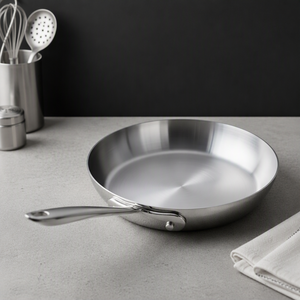
Commercial 201/304 Stainless Steel Frying Pan 3.0mm Heavy Duty
- Thickness: 3.0mm Heavy-Gauge Steel
- Target: High-Volume Restaurant Use
- Handle: Ergonomic Steel Tubular Riveted

Professional 3-Ply Cooking Pot & Skillet Honeycomb Nonstick Pan
- Structure: Full Clad 3-Layer Metallurgy
- Scratch Protection: Metal Utensil Safe
- Base Type: Encapsulated Induction Disc

TIANXING Multi-Ply Professional Clad Pots & Pans Set OEM
- Configuration: Commercial 10-Piece Set
- Certification: ISO 9001, CE, Food Grade
- Heat Transfer: 360-Degree Uniform Thermal Wall

Custom Tri-Ply Frying Pan 22CM 18/8 304 Steel With Lid
- Steel Grade: Premium 18/8 (SUS304) Contact
- Lid System: Tempered Glass / Steel Rim
- Branding: OEM Custom Logo & Packaging
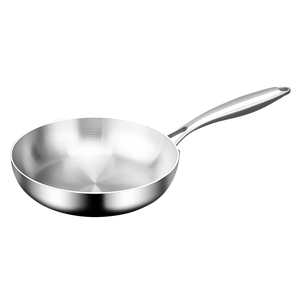
Five-Ply Clad 304 Stainless Steel 8-Inch Eco-Friendly Pan
- Layer Count: 5-Ply Superior Heat Retention
- Eco Standard: PFOA / Lead / Zinc Free
- Deformation: Zero Heat Warping Guarantee

Modern Nonstick Stainless Steel Fry Pan Round Honeycomb Design
- Nonstick Tech: Hybrid Laser Engraved Texture
- Oven Safe: Up to 260°C / 500°F
- Base Fit: Flat Magnetic Induction Plate
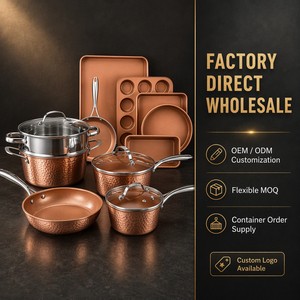
Hammered Copper Nonstick Induction Cookware Set OEM Wholesale
- Aesthetic: Artisanal Hammered Finish
- Induction Compatible: Stainless Steel Bottom Base
- Application: Luxury Hotel & Buffet Display
Evaluating the Top 10 Commercial Induction Cookware Sets Manufacturers & Suppliers
The global transition from traditional open-flame gas burners to high-efficiency induction cooking platforms across commercial kitchens—including Michelin-starred venues, institutional catering centers, and international hotel chains—has fundamentally altered the engineering criteria for commercial cookware. Commercial induction surfaces rely on high-frequency electromagnetic fields (typically 20 kHz to 50 kHz) to generate eddy currents directly inside the ferromagnetic layer of cookware. Consequently, selecting a tier-one commercial induction cookware supplier is no longer a matter of basic aesthetics; it is a critical metallurgical decision that directly impacts energy consumption, cook-line throughput, and kitchen thermal management.
Core Procurement Insight: In high-frequency commercial kitchens, inferior encapsulated bottom pans suffer from thermal warping, delamination, and magnetic hysteresis failure within 3 to 6 months of continuous operation. Top-tier manufacturers utilize 3-Ply or 5-Ply full-body cladding with AISI 430 magnetic steel bases, guaranteeing dimensional stability and maximum energy transfer efficiency exceeding 90%.
Key Industry Criteria for Top 10 B2B Supplier Ranking
When enterprise procurement teams, global hotel group sourcing managers, and private label brand owners evaluate commercial cookware manufacturers, the following four engineering benchmarks determine ranking leadership:
1. Ferromagnetic Base Permeability
Top suppliers specify AISI 430 (18/0) stainless steel for the exterior induction base. This grade possesses optimal magnetic permeability, allowing immediate coupling with induction coils without triggering inverter fault codes or thermal cut-offs during peak service hours.
2. Multi-Clad Metallurgical Bonding
Rather than using cheap impact-bonded discs that trap air pockets, high-tier OEMs employ continuous roll-bonding press technology under 2,000+ tons of pressure. High-pure pure aluminum (1050 alloy) is sandwiched between food-grade 304 steel and magnetic 430 steel to guarantee uniform edge-to-edge heat dispersal.
3. Hybrid Surface Longevity
Nonstick performance in commercial kitchens has historically failed due to spatula scraping. Leading factories integrate micro-laser etched honeycomb stainless steel grids that physically shield PFOA-free coatings from metal utensil abrasion while maintaining quick-release properties.
4. Asset Traceability & QC Verification
Industrial buyers demand strict batch consistency. Advanced facilities implement permanent laser Data Matrix barcoding directly into metal handles or bases, binding raw material mill test certificates (MTC), heat codes, and ISO quality inspection records to every individual unit.
Commercial Induction Cookware Construction Comparison
Technical comparison matrix analyzing structural integrity, energy efficiency, and operational lifespan across commercial cookware manufacturing methodologies.
| Spec Parameter | Impact-Bonded Disc Base | 3-Ply Clad (Full Body) | 5-Ply Premium Commercial | Honeycomb Laser Hybrid |
|---|---|---|---|---|
| Layer Composition | 201/304 Steel + Alu Disc + 430 Base | 304 Interior + Alu Core + 430 Base | 304 + 3-Layer Alu Core + 430 Exterior | Tri-Ply / 5-Ply + Etched Matrix |
| Heat Distribution | Bottom Only (Hot Spot Edges) | 100% Uniform Wall & Base | Maximum Retention & Thermal Mass | Uniform + Protected Coating |
| Induction Efficiency | 82% - 87% | 92% - 95% | 96% - 98% | 93% - 96% |
| Thermal Shock Tolerance | Moderate (Risk of Disc Pop) | High (Zero Separation) | Extreme (Heavy Duty Commercial) | High (Resists Metal Utensils) |
| Expected Service Life | 1 - 2 Years | 5 - 8 Years | 10+ Years (Lifetime Commercial) | 3 - 5 Years Hard Use |
| Suitability Benchmark | Low-Budget Catering | Standard Restaurant Line | High-Volume / Fine Dining | Breakfast Buffets / Sauté Lines |
| B2B Procurement Tier | Economy Tier | Commercial Standard | Enterprise Grade | Specialized Line |
Future Sourcing & Manufacturing Trends (2025–2030)
The global OEM/ODM procurement landscape for commercial kitchen equipment is undergoing significant structural shifts. Procurement directors must anticipate the following technological trends to maintain competitive margin structures and operational excellence:
1. Elimination of PFAS/PFOA Chemical Coatings
Global regulatory bodies (EU REACH, US EPA) are systematically banning fluorinated organic compounds. Global commercial buyers are actively transitioning to ceramic-reinforced matrices, physical micro-structured honeycomb steel surfaces, and ultra-hard 25-micron protective ceramic passivation layers that eliminate chemical degradation during high-heat searing.
2. Smart Kitchen & RFID/Data Matrix Integration
Modern commercial kitchens are introducing automated inventory systems and cook-station temperature tracking. Industrial suppliers are incorporating permanently laser-etched Data Matrix codes directly onto cookware handles and vessel bottoms. This allows automated tracking of pot usage cycles, sanitation validation, and automated replenishment schedules across multi-property hospitality groups.
3. Circular Metallurgy & Carbon Footprint Auditing
Sustainability compliance is now a prerequisite for enterprise contracts. Leading factories are utilizing up to 80% recycled premium stainless steel alloys (SUS304/SUS430), scrap metal recovery programs during deep-drawing stages, and energy-efficient induction annealing ovens to meet European carbon border adjustment requirements (CBAM).
Commercial Induction Cookware Procurement FAQ
Technical and logistics answers for procurement managers, distributors, and commercial kitchen suppliers.
The gold standard for commercial induction cookware is a 3-Ply or 5-Ply clad structure comprising an interior layer of food-grade AISI 304 (18/8) Stainless Steel for non-reactive food contact, a heavy aluminum core (1050/1100 alloy) for thermal conductivity, and an exterior layer of ferromagnetic AISI 430 (18/0) Stainless Steel to ensure high efficiency on magnetic induction cooktops.
Impact-bonded disc bottoms consist of an aluminum plate welded only to the base of the pan. Under continuous thermal cycling in busy commercial kitchens, differential thermal expansion causes disc delamination, trapping grease, creating hot spots, and eventually leading to disc detachment. Full tri-ply cladding extends the aluminum layer seamlessly up the sidewalls, providing 360° heat transfer and structural warp resistance.
Laser honeycomb technology micro-engraved a raised stainless steel grid pattern over the nonstick interior surface. When metal spatulas or tongs are used, they glide over the elevated stainless steel ridges, leaving the recessed nonstick valleys untouched. This hybrid design delivers quick food release while extending commercial service life by 300% compared to smooth nonstick surfaces.
For customized OEM/ODM commercial cookware orders—including custom gauge thickness, handle design, bottom stamping, and packaging—standard factory MOQs range between 300 to 500 sets per item. Production lead times typically range from 30 to 45 days after prototype sample approval, with direct FOB shipping from Sialkot/Karachi ports.
International buyers should require ISO 9001 (Quality Management Systems), CE certification, ISO 8442 (Materials in Contact with Food), and full REACH compliance verification to ensure products are completely free from dangerous levels of Lead, Cadmium, Zinc, PFOA, and PFAS compounds.
Ready to Elevate Your Commercial Cookware Line?
Partner directly with a certified export manufacturer. Request custom OEM/ODM quotes, technical material data sheets, and factory direct samples today.
Inquire Now