


Industry Insights & Manufacturing Blog
Explore expert technical guides, material standards, and global supply chain updates from Prowa Kitchenware Industries.
Featured OEM Wholesale Cookware Series
Engineered for commercial food service, retail private labeling, and high-volume wholesale distribution. Explore our flagship non-stick fry pans, multi-ply clad stockpots, and hybrid sets.

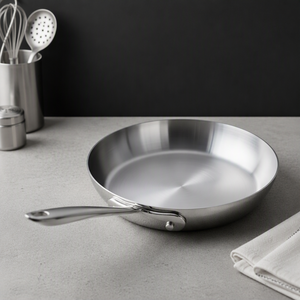



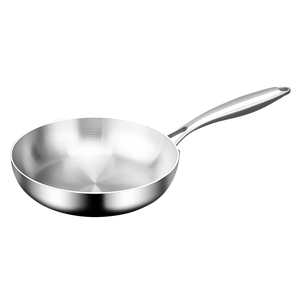

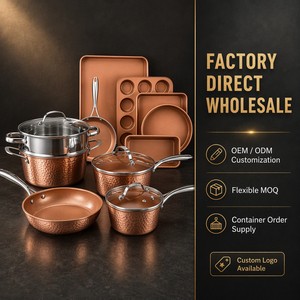
Technical White Paper: Engineering Specifications for Custom OEM Non-Stick Cookware Manufacturing
When enterprise B2B buyers, global department store category managers, and commercial hospitality distributors evaluate custom OEM wholesale non-stick cookware sets factories & exporters, evaluating surface coating longevity alone is insufficient. Modern cookware engineering requires a holistic assessment of thermal diffusivity, substrate alloy grain structure, multi-ply cladding bonding integrity, and environmental chemical compliance.
At our integrated manufacturing hub in Sialkot, Pakistan (Prowa Kitchenware Industries), we engineer cookware from raw metal coil to finished packaged set under strict ISO 9001 and CE frameworks. This white paper serves as an authoritative technical benchmark for procurement specialists seeking to optimize their supply chain performance, minimize warranty return rates, and capture market share through high-margin private-label product lines.
1. Substrate Metallurgy: Tri-Ply Cladding vs. Heavy-Gauge Forged Aluminum
The structural core of any premium cookware vessel dictates heat distribution efficiency and mechanical warp resistance under high-BTU thermal stress. We utilize two primary metallurgical architectures:
- Tri-Ply Stainless Steel Cladding (SUS304 / AL 1050 / SUS430): Consisting of an interior 18/8 (SUS304) food-contact surface, a pure aluminum (1050 alloy) heat-spreading core, and an exterior magnetic stainless steel (SUS430) skin. Cold-rolled under high hydrostatic pressure, this composite eliminates hotspots by distributing thermal energy laterally at a rate of 237 W/m·K across the pan's base and sidewalls simultaneously.
- Cold-Forged Heavy-Gauge Aluminum (3.0mm – 5.0mm Caliber): For lightweight culinary applications, cold-forged aluminum offers superior impact resistance compared to standard sheet stamping. Dynamic thickness distribution places maximum metal density at the base stress zone (preventing thermal bowing under rapid temperature changes) while maintaining thin sidewalls to reduce container shipping weight.
2. Non-Stick Coating Chemistry & Surface Micro-Structuring
Coating delamination remains the primary vector for consumer warranty claims in mass-market cookware. To mitigate this risk, our facility employs multi-layer fluoropolymer and ceramic matrix systems engineered for high-friction commercial environments:
- Sol-Gel Organic Ceramic Matrices: Derived from silica-based inorganic polymers, ceramic non-stick coatings are inherently 100% PFOA, PTFE, Lead, and Cadmium-free. Cured at 400°C, these surfaces achieve a surface hardness rating up to 9H Pencil Hardness, resisting thermal degradation up to 450°C.
- Laser-Engraved Micro-Honeycomb Hybrid Protection: As demonstrated in our flagship honeycomb fry pan series, a elevated 316/304 stainless steel grid matrix is laser-etched directly into the inner vessel wall over the non-stick coating layer. This structural shield bears the mechanical wear of metal spatulas and forks, allowing the non-stick valleys to remain untouched, thereby extending non-stick release life by over 300% compared to flat non-stick surfaces according to BS EN 12983-1 abrasion testing.
Cookware Substrate & Coating Comparison Matrix
Direct comparative engineering data to assist B2B purchasing directors in selecting optimal product specifications based on target market price points and performance requirements.
| Architecture Type | Material Core Composition | Thermal Conductance Rate | Surface Hardness / Abrasion Life | Induction Compatibility | Regulatory Compliance |
|---|---|---|---|---|---|
| Tri-Ply Honeycomb Hybrid | SUS304 + Pure AL 1050 + SUS430 | Very High (237 W/m·K) | > 50,000 Cycles (BS EN 12983-1) | Direct Full-Surface Magnetic | FDA, LFGB, REACH, EU 1935/2004 |
| Hard-Anodized Aluminum | Al2O3 Electro-Chemical Layer | High (210 W/m·K) | > 35,000 Cycles (Dual Layer PTFE) | Impact-Bonded SUS430 Disc | FDA, LFGB, Prop 65 Compliant |
| Sol-Gel Ceramic 5-Ply | 5-Ply Clad + Silica Polymer Matrix | High Uniformity Core | > 20,000 Cycles (9H Hardness) | Direct Magnetic Stainless Outer | 100% PFAS / PFOA / GenX Free |
| Commercial 201 Stainless | 201 Austenite (15% Cr, 1% Ni) | Medium (16 W/m·K Base Only) | Bare Steel / Optional Coating | Impact Disc Required | Standard ISO Food Contact Safe |
Macro Procurement Trends in Wholesale Cookware Sets (2025–2030)
The global cookware manufacturing landscape is undergoing a structural transition driven by changing regulatory imperatives, ESG consumer preferences, and technological shifts in commercial kitchens. Exporters and OEM factories that fail to adapt to these technical standards expose importers to inventory obsolescence and customs enforcement actions.
1. Universal Regulatory Elimination of PFAS, PFOA, and Fluoropolymer Precursors
Regulatory authorities in the European Union (under proposed REACH restriction updates) and North America (state-level legislation such as California AB 1200 and Maine PFAS bans) are phasing out traditional fluorinated surface chemistries. Procurement strategies must prioritize PFAS-free Sol-Gel ceramics or hybrid mechanical armor surfaces (such as laser-etched honeycomb multi-ply stainless steel) to maintain friction-free cooking without regulatory exposure.
2. The Rise of High-Efficiency Full-Cap Induction Bonding
As commercial and residential kitchens migrate from gas combustion burners to high-frequency induction hobs, traditional spot-welded induction discs are proving inadequate due to delamination caused by differential thermal expansion. Modern OEM buyers require full-cap impact bonding—where a 0.5mm SUS430 magnetic stainless steel plate is fused under 2,500 tons of friction hydraulic pressure at 500°C. This ensures zero air gaps, maximum electromagnetic permeability, and zero risk of base detachment over thousands of thermal cycles.
3. Digital Supply Chain Transparency: Unit-Level Data Matrix Laser Barcoding
Leading global brands are demanding end-to-end traceability across their contract manufacturing facilities. In response, Prowa Kitchenware Industries has pioneered the integration of Data Matrix Laser Barcoding directly onto cookware bottoms and handles. Laser-etched at a depth of 25 microns, each unique Data Matrix code stores production batch metadata, material heat number, QC audit timestamps, and factory origin details. This allows retail importers to instantly verify authenticity, streamline warranty tracking, and perform pinpoint product recalls if necessary.
Prowa Kitchenware OEM/ODM Capabilities
Why leading global distributors and private-label brands choose our Sialkot manufacturing hub for their custom cookware production.
Full In-House Tooling & ODM Design
From 3D CAD modeling and rapid prototyping to custom deep-draw stamping dies and ergonomic handle molding. We reduce custom OEM tooling lead times to under 25 days.
Stringent International Quality Certifications
Certified according to ISO 9001, ISO 8442, ISO 4957, ISO 15510, CE, and GMP standards. Every batch undergoes 100% visual, coating thickness, and thermal shock testing.
100% Export-Oriented Logistics Supply Chain
Located in Sialkot, Pakistan, with streamlined access to international shipping ports. We specialize in custom palletization, drop-test-certified mail-order packaging, and FCL/LCL delivery.
Frequently Asked Procurement Questions (FAQ)
Direct answers to crucial commercial and engineering questions faced by global cookware buyers during supplier auditing and RFQ creation.
Partner with a Leading OEM Cookware Factory
Looking to launch a custom non-stick cookware set or upgrade your current commercial supply chain? Request a direct factory quotation, custom tooling assessment, or material specification sample today.