


Industry Insights & Manufacturing Blog
Explore expert technical guides, material standards, and global supply chain updates from Prowa Kitchenware Industries.
Curated Selection: High-Performance Clad Stainless Steel Cookware
Direct factory export offerings featuring tri-ply roll-bonding, micro-engraved honeycomb nonstick matrices, and commercial-grade SS304/SS430 multi-clad engineering.

Tri-Ply Honeycomb Non-Stick Induction Skillet
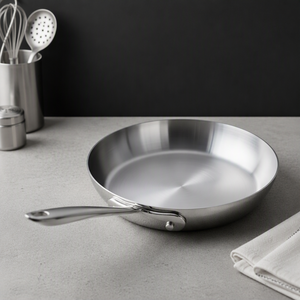
Commercial 3.0mm Heavy-Duty Restaurant Fry Pan

Professional 3-Layer SS304 Honeycomb Skillet

Multi-Ply Clad Professional Cookware Set

Custom 22CM 18/8 Tri-Ply Pan with Tempered Lid
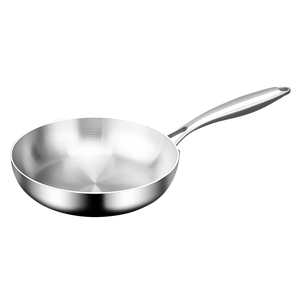
Five-Ply (5-Ply) Clad Premium 8-Inch Skillet

Modern Laser Engraved Honeycomb Hybrid Pan
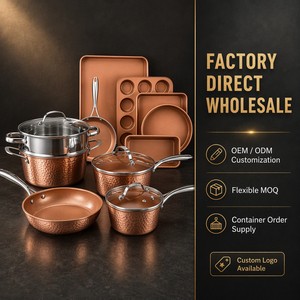
Hammered Copper & Multi-Clad Luxury Cookware Set
Engineering Excellence: The Metallurgy of Multi-Layer Clad Stainless Steel Cookware
In high-performance commercial and residential culinary environments, single-ply stainless steel cookware suffers from a fundamental physical limitation: poor thermal conductivity. While austenitic stainless steel (such as AISI 304 / 18/8) delivers unmatched corrosion resistance, structural integrity, and chemical inertness, its thermal conductivity coefficient is relatively low (approximately 15 W/m·K). Conversely, pure aluminum (1050/3003 alloy) boasts exceptional heat diffusivity (~220 W/m·K) but lacks magnetic responsiveness for induction cooktops and degrades easily under mechanical stress.
To bridge this technological gap, top Chinese cookware exporters and global manufacturing partners—such as Prowa Kitchenware Industries—employ advanced high-pressure hot-roll bonding metallurgical techniques. Multi-layer clad stainless steel (Tri-Ply, 5-Ply, and Copper-Core Cladding) permanently fuses distinct metallic alloys at atomic levels, creating a composite material that exhibits hyper-uniform heat transfer, zero hot-spot warping, and universal stovetop compatibility.
Anatomical Breakdown of Clad Material Stacks
Understanding the internal structure of multi-clad cookware is paramount for global procurement directors, OEM brand managers, and commercial kitchen suppliers:
| Cladding Configuration | Layer Architecture (Inside to Outside) | Thermal Conductivity | Primary B2B Target Market |
|---|---|---|---|
| Tri-Ply (3-Ply Full Clad) | SS304 (Interior) + Pure Aluminum Core + SS430 (Magnetic Exterior) | High (~160 W/m·K effective) | Premium Retail, E-Commerce Brands, Consumer Home Kitchens |
| Five-Ply (5-Ply Heavy Clad) | SS304 + Al Alloy + Pure Al + Al Alloy + SS430 Magnetic Steel | Very High (Superior Heat Retention) | Commercial Catering, Culinary Schools, High-End Hospitality |
| Copper-Core Clad (5-Ply/7-Ply) | SS304 + Aluminum + Pure Copper Core + Aluminum + SS430 | Ultra-High (~380 W/m·K Core) | Professional Chef Lines, Luxury Cookware Brands, Gourmet Outlets |
| Hybrid Honeycomb Tri-Ply | Micro-Etched SS304 Matrix + PFOA-Free Coating + Al Core + SS430 | High + Non-Stick Protection | Modern Domestic Kitchens, Heavy Sear & Low-Oil Cooking Lines |
Physical Non-Stick Mechanics: Micro-Etched Honeycomb Matrix
Traditional non-stick coatings applied directly to smooth aluminum surfaces degrade rapidly when exposed to stainless steel spatulas, high heat searing (>260°C), or abrasive dishwasher detergents. Leading OEM exporters have overcome this durability bottleneck by developing the Laser Micro-Etched Honeycomb Tri-Ply Structure.
This manufacturing process uses precision laser engraving to carve a raised stainless steel hexagonal grid over the interior 304 stainless steel surface layer. The non-stick coating (ceramic or PTFE-free formulations) is deposited into the microscopic valleys below the raised steel ridges. When cooking, spatulas and cutlery ride exclusively along the elevated stainless steel peaks, protecting the underlying non-stick coating from mechanical abrasion while maintaining effort-free food release.
Key Technical Innovations in Modern Clad Manufacturing
Atomic Roll-Bonding
High-tonnage cold & hot rolling mill technology ensures permanent intermetallic diffusion across 304, aluminum, and 430 layers without delamination risk under thermal stress.
Safety & Food Contact Standards
Strict compliance with FDA, LFGB, REACH, and ISO 8442 parameters. Zero PFOA, zero heavy metal leaching (lead/zinc free), and 25-micron protective surface treatments.
Data Matrix Barcoding Traceability
Industry-first laser-engraved Data Matrix codes directly on cookware bodies for permanent lifecycle traceability, heat number recording, and quality auditing.
Global B2B Procurement Benchmarks & Quality Control Protocols
When sourcing multi-layer clad stainless steel cookware from China and global OEM supply chains, procurement teams must implement rigid Quality Assurance (QA) metrics. Unlike basic single-ply aluminum pans, clad steel requires precise metallurgical validation to prevent field failures such as bottom warping, rim separation, or localized pitting corrosion.
1. Thermal Shock & Delamination Resistance Testing
High-tier factories submit production samples to rigorous thermal stress protocols. Pans are heated to an internal temperature of 280°C (536°F) and immediately quenched in 15°C cold water. This thermal shock cycle is repeated 50 consecutive times. The clad material must show zero boundary separation, micro-cracking, or base deformation, maintaining planar bottom flatness within 0.2mm for optimal induction hob energy transfer.
2. Salt Spray Corrosion & Acid Resistance Audits
To verify the purity of the interior SS304 (18/8) layer, raw materials undergo standardized 72-hour neutral salt spray (NSS) testing per ISO 9227 standards. Furthermore, pans undergo boiling tests in 4% acetic acid solutions for 6 hours to guarantee zero nickel or chromium ion migration into food during slow acidic cooking (e.g., tomato sauces or wine reductions).
3. Handle Joint Shear Strength & Ergonomic Load Testing
Commercial kitchen safety requires handle assemblies to withstand high mechanical leverage. Whether utilizing heavy-duty stainless steel rivets or high-frequency spot welding, handles are tested under static loads exceeding 50 kg and dynamic fatigue testing over 10,000 lifting cycles without structural yield.
Enterprise Supply Capabilities: Prowa Kitchenware & Integrated Global OEM Manufacturing
Standing alongside top-tier Chinese multi-layer clad factories, Prowa Kitchenware Industries represents an elite manufacturing partner for global brands, hospitality distributors, and private-label importers. Operating out of an advanced integrated facility, Prowa manages the entire spectrum of metal transformation under stringent international management frameworks.
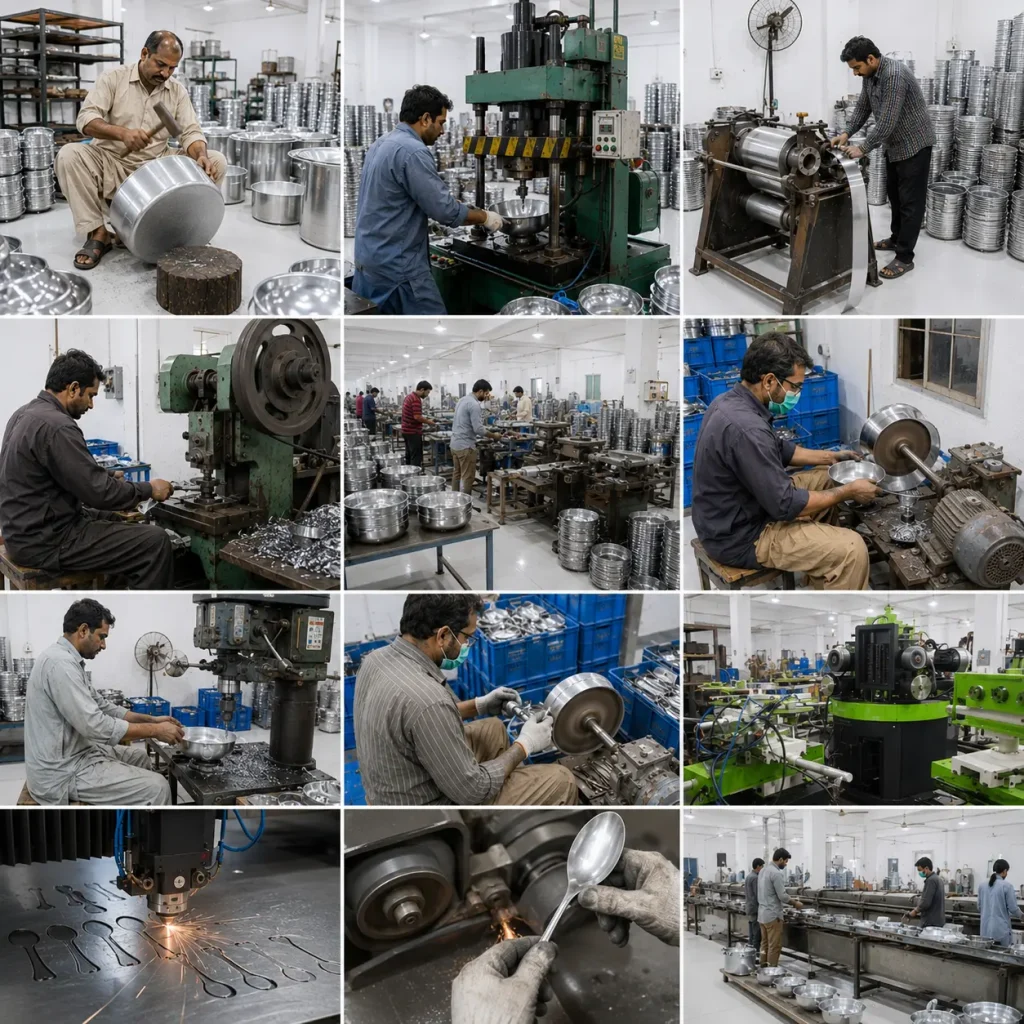
Key Operational Pillars & Certifications:
- Comprehensive Certifications: Fully certified under CE, ISO 9001, ISO 8442, ISO 4957, ISO 15510, GMP, and REACH compliance, guaranteeing seamless customs clearance in North America, Europe, and the Middle East.
- Dual Safety Venting Systems: Integrated engineered safety valves (calibrated to 12 PSI) across commercial pressure lines and sealed lid systems.
- Precision Material Utilization: Advanced blanking and deep-drawing automation saves over 180 Tons of raw stainless steel scrap annually, directly lowering per-unit production costs for B2B buyers.
- Industry-First Data Matrix Traceability: Permanent laser marking technology allows full inventory visibility from raw coil batch numbers down to individual store shelves.
Strategic Market Outlook: Cookware Procurement & Manufacturing Trends (2025–2030)
As global regulations on fluorinated chemicals (PFAS/PFOA) tighten across the European Union (REACH Annex XVII updates) and the United States (EPA regulations), the commercial cookware landscape is undergoing a massive structural pivot towards eco-friendly multi-layer clad stainless steel alternatives.
1. The Rapid Phase-Out of Traditional Chemical Non-Stick Surfaces
Importers and brand owners are aggressively reducing reliance on standard PTFE coatings. The industry standard is rapidly shifting towards Pure Uncoated Tri-Ply Stainless Steel, Ceramic-Sol-Gel Hybrid Cladding, and Laser Micro-Etched Stainless Steel Ridges. These technologies provide everlasting non-stick performance without regulatory compliance risk.
2. Rise of Smart Manufacturing & Automated Inspection
Leading Chinese exporters and progressive global hubs are integrating automated optical inspection (AOI) systems onto stamping and polishing lines. Optical sensors measure wall thickness variations down to 0.01mm, ensuring that 5-Ply clad cookware maintains perfect thermal symmetry and weight balance.
3. Multi-Regional Supply Chain Resilience (China + Global OEM Networks)
Strategic B2B buyers are increasingly adopting a "China Plus One" or integrated global sourcing model. Combining China's vast raw material supply chains with secondary manufacturing hubs like Sialkot, Pakistan allows enterprise buyers to optimize tariff structures, mitigate geopolitical logistics bottlenecks, and maintain competitive landed costs.
Frequently Asked Questions: B2B Sourcing & Technical Insights
Expert answers to standard procurement, metallurgical, and factory customization questions.
Partner with Leading Clad Stainless Steel Manufacturers
Request factory-direct quotations, technical specs, material test reports, or sample kits for your OEM/ODM cookware lines today.