


Industry Insights & Manufacturing Blog
Explore expert technical guides, material standards, and global supply chain updates from Prowa Kitchenware Industries.
Featured Professional Restaurant Cookware Line
Rigorous tri-ply clad metallurgy, bionic honeycomb laser etching, and heavy-gauge construction built to withstand continuous back-of-house culinary operations.

Triply Stainless Steel Honeycomb Induction Non-Stick Skillet
- Grade 304 Interior + Pure Al Core + 430 SS
- Laser-Etched Micro-Honeycomb Barrier
- Commercial Induction & Flame Compatible
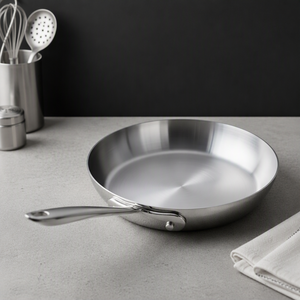
Heavy-Duty 3.0mm Stainless Steel Commercial Fry Pan
- 3.0mm Extra-Thick Thermal Wall
- Reinforced Ergonomic Stay-Cool Handle
- Warp-Resistant Heavy Restaurant Use

Professional 3-Layer Clad 304 Non-Stick Honeycomb Stock Pot & Skillet
- Seamless Rim-to-Base Heat Transfer
- Scratch-Resistant Metal Utensil Safe
- Reduced Energy Consumption Design

Multi-Ply Commercial Stainless Steel Cookware Set
- Full Suite OEM Kitchenware Configurations
- Commercial Dishwasher & Oven Safe
- Precision Riveted Stainless Fasteners

Customized 18/8 304 Tri-Ply Skillet with Tempered Glass Lid
- 18/8 Food-Grade Non-Reactive Surface
- Tailored Branding & Volume Markings
- Rapid Uniform Thermal Conduction
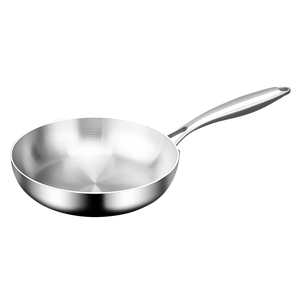
Eco-Friendly 5-Ply Clad 304 Stainless Steel Commercial Pan
- 5-Layer Extreme Heat-Retention Core
- 100% PFOA, Lead & Zinc Free Certified
- Precision Sealed Dripless Pouring Lip

Modern Bionic Honeycomb Non-Stick Round Chef Fry Pan
- Hybrid Stainless Shielding Technology
- High-Sear Capability with Low Oil Usage
- Extended Operational Lifespan
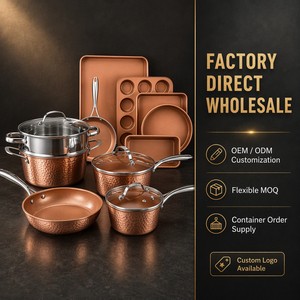
Luxury Hammered Copper Tri-Ply Cookware & Stockpot Suite
- Front-of-House Executive Display Quality
- Bimetallic Copper Exterior & Induction Base
- Heavy Commercial Cast Stainless Handles
Strategic Manufacturing Infrastructure: Why Global Hospitality Chains Sourcing from Premier Chinese Factories Gain Unmatched Competitive Edge
The global commercial food service industry is undergoing a structural paradigm shift. Hospitality groups, hotel chains, and enterprise restaurant equipment distributors no longer evaluate procurement suppliers solely on unit price. Instead, procurement directors demand rigorous operational resilience, metallurgic purity, thermal cycle efficiency, and comprehensive supply chain traceability. As the undisputed hub of worldwide stainless steel and aluminum processing, China’s top-tier professional restaurant kitchenware manufacturers provide the engineering benchmark for global kitchens.
Key Takeaway for B2B Buyers: Modern commercial kitchens operate under severe continuous thermal stress. Sourcing engineered Tri-Ply (304 Stainless Steel + Pure Aluminum Core + 430 Magnetic Stainless Steel) eliminates structural hot spots, reduces kitchen operational gas/electric utility consumption by up to 28%, and prevents pan warping under rapid cold-water thermal shock quenching.
Advanced Metallurgical Engineering & Material Database Integrity
Commercial cooking equipment must withstand aggressive chemical dishwashing detergents, physical metal utensil abrasion, and continuous thermal cycling ranging from sub-zero holding to over 350°C open-flame searing. Premium production facilities utilize strict material grade control compliant with international standards, including ISO 8442 (Materials in Contact with Food), ISO 4957 (Tool Steels), and ISO 15510 (Stainless Steels Composition):
304 Food-Grade Austenitic Steel
Formulated with 18% Chromium and 8% Nickel, creating an impenetrable passive chromium-oxide layer that resists acidic organic sauces and alkaline sanitation chemicals.
Encapsulated Aluminum Core
High-purity 1050/1100 aluminum alloy thermal bridge sandwiched between steel layers, spreading heat laterally across 100% of the cook surface within seconds.
430 Ferritic Magnetic Exterior
High-density magnetic exterior shell specifically calibrated for maximum energy coupling efficiency on high-frequency commercial induction cooktops.
Comparative Metallurgy Matrix: Commercial Cookware Engineering Standards
Below is an executive technical comparison detailing structural performance across various commercial cookware formulations used in back-of-house operations.
| Material Architecture | Thermal Conductance (W/m·K) | Tensile Strength (MPa) | Deformation Temp Threshold | Induction Compatibility | Relative Operational Lifespan |
|---|---|---|---|---|---|
| Tri-Ply Full Clad (304-Al-430) | 160 - 180 W/m·K | ≥ 520 MPa | > 450°C | 100% Optimized | 10 - 15+ Years (Heavy Use) |
| 5-Ply Heavy Armor Clad | 190 - 210 W/m·K | ≥ 580 MPa | > 550°C | 100% Optimized | 15 - 20+ Years (Extreme Line) |
| Single-Ply Disc Bottom 201 SS | 15 - 20 W/m·K (Base local) | ≥ 380 MPa | ~ 280°C (Risk of base delamination) | Varies (Disc Dependent) | 2 - 4 Years |
| Commercial Cast Aluminum (Die-Cast) | 120 - 140 W/m·K | ≥ 240 MPa | ~ 300°C | Requires Spray/Bond Base | 3 - 5 Years |
| Hammered Bimetallic Copper-Clad | 380 - 400 W/m·K | ≥ 400 MPa | > 400°C | Specialized Tri-Base Only | 8 - 12 Years (Display Kitchens) |
Industry-First Digital Traceability: Laser-Engraved Data Matrix Barcoding
Modern hospitality supply chains demand absolute provenance verification. Top OEM manufacturing facilities integrate permanent 2D Data Matrix laser marking directly onto cookware bodies. Unlike paper stickers or traditional stamping that degrade under heat and washing, laser-engraved Data Matrix codes store non-tamperable digital records directly on the metal surface:
- Batch Traceability: Scannable via industrial inventory systems to verify steel heat numbers, raw material melt batches, and precise manufacturing timestamps.
- Quality Control Compliance: Instant access to factory hydrostatic test records, 12 PSI safety valve calibration logs, and post-annealing grain structure audits.
- Asset Tracking for Hotel Chains: Enables digital asset management across international property portfolios, preventing cross-location inventory loss during banquets and catering operations.
Future Procurement Trends & Development Horizons in Commercial Kitchenware
1. The Transition to Bionic Honeycomb Physical Non-Stick Barriers
Traditional chemical non-stick coatings (such as smooth PTFE surfaces) frequently degrade when exposed to commercial stainless steel spatula scraping or aggressive high-heat flash frying. The industry has rapidly pivoted to laser-etched micro-honeycomb matrix structures. By raised stainless steel ridges over a recessed non-stick basin, metal utensils glide harmlessly across the steel peaks without contacting the protective non-stick coating below. This hybrid design delivers high-temperature searing capabilities while retaining effortless food release and extending product service life threefold.
2. Eco-Friendly Manufacturing & Zero-PFAS Global Regulatory Compliance
With North American and European regulatory bodies enforcing stringent bans on toxic forever chemicals (PFOA, PFOS, Lead, and Cadmium), tier-one Chinese exporters have completely overhauled chemical surface passivations. Advanced 25-micron invisible protective surface layers produced via eco-friendly electro-polishing eliminate toxic off-gassing at temperatures exceeding 300°C, ensuring total compliance with EU REACH and US FDA food contact directives.
3. Sustainable Supply Chain Architecture & Recycled Metal Utilization
Leading enterprise factories have achieved substantial environmental impact milestones through closed-loop metal recycling programs. By re-smelting and re-stamping stainless steel off-cuts directly within controlled production loops, factories save over 180 metric tons of raw metal annually. Global procurement officers increasingly leverage these certified green credentials to fulfill corporate ESG (Environmental, Social, and Governance) targets.
ESG Supply Chain Alignment: Sustainable commercial kitchenware manufacturing reduces total lifecycle carbon footprint by up to 34% compared to virgin ore processing. Inquire about our recycled-content certification documentation for enterprise tenders.
Why Direct OEM Manufacturing Sourcing Delivers Unmatched Operational Value
Partnering directly with a fully integrated, export-dedicated kitchenware manufacturer removes intermediary markups while providing end-to-end custom engineering capabilities tailored for global distributors and private label brand owners.
Complete In-House Tooling & Die Design
Custom deep-drawing, hydraulic pressing, and handle mould fabrication executed by specialized tooling engineers for bespoke product shapes.
Rigorous Hydrostatic & Safety Testing
Pressure vessel products undergo 100% automated pressure testing with dual-valve safety release systems calibrated precisely to 12 PSI.
OEM Branding & Packaging Customization
Precision laser etching, custom handle rivet patterning, retail color box design, and industrial barcode palletization.
Commercial Kitchenware Sourcing Frequently Asked Questions (FAQ)
Essential guidance for corporate procurement officers, hotel group buyers, and commercial equipment importers.
What is the structural difference between Tri-Ply Clad and Impact-Bonded Disc Bottom Cookware?
Tri-Ply Clad cookware features a continuous 3-layer metallurgical sandwich (Stainless Steel / Aluminum / Stainless Steel) extending seamlessly from the base all the way up the side walls to the rim. This guarantees uniform lateral heat distribution throughout the entire vessel body. In contrast, impact-bonded disc cookware only features an aluminum slab attached to the bottom surface, leaving the side walls as single-ply steel which can lead to scorch rings where the base meets the vertical wall.
Why is Grade 304 Stainless Steel preferred over Grade 201 for heavy commercial restaurant use?
Grade 304 contains a minimum of 18% Chromium and 8% Nickel, giving it exceptional resistance to acid corrosion (from tomatoes, wine reductions, vinegar) and heavy industrial chemical dishwashing. Grade 201 substitutes Manganese for Nickel; while cost-effective for light domestic use, 201 steel is far more susceptible to pitting corrosion and rust under continuous high-volume commercial restaurant conditions.
How does laser-etched honeycomb technology extend non-stick skillet durability?
The laser etching process creates a raised web matrix of stainless steel ridges. When commercial chefs use metal spatulas, tongs, or whisks, the metal contacts only the raised stainless steel peaks. The non-stick coating sits in the recessed valleys between the peaks, remaining completely protected from mechanical scratching and abrasion.
What custom OEM/ODM parameters can be specified during factory production ordering?
Buyers can customize vessel wall thickness (e.g., 0.8mm to 3.0mm), bottom cladding layers (Tri-Ply vs 5-Ply), handle ergonomics (hollow stay-cool cast stainless vs silicone sleeve), surface finish (mirror polish, satin brush, copper hammered), internal liquid volume scale markings, laser-etched brand logos, and custom retail or bulk master carton packaging.
How does Data Matrix barcoding streamline institutional kitchenware inventory?
Data Matrix barcoding provides a permanent 2D laser-etched identifier on each unit. Institutional kitchens and hospitality management software scan these codes to track product lifecycle, maintenance intervals, sanitization cycles, and asset movement across multi-property hotel locations without relying on external stickers that wash off.
Ready to Upgrade Your Commercial Kitchenware Supply Chain?
Connect with our technical engineering team for factory-direct wholesale pricing, custom OEM samples, and comprehensive metallurgical specifications tailored to your brand standards.