


Industry Insights & Manufacturing Blog
Explore expert technical guides, material standards, and global supply chain updates from Prowa Kitchenware Industries.
CE Certified Commercial Non-Stick Cookware Portfolio
Engineered for commercial food service, hospitality distributors, and private label importers requiring strict European safety standards and maximum thermal efficiency.

Induction Non Stick Skillet Triply Stainless Steel Honeycomb Cookware
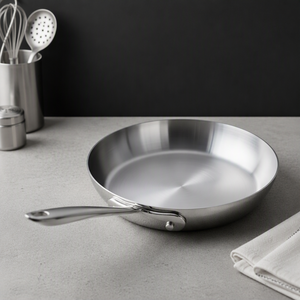
Commercial 201 Stainless Steel Frying Pan 3.0mm Thickness

Professional 304 Tri-Ply Stainless Steel Honeycomb Skillet

TIANXING Multi-Ply Stainless Steel Tri-Ply Clad Cookware OEM

Custom 18/8 304 Stainless Steel 22CM Tri-Ply Skillet with Lid

Five-Ply Clad 304 Stainless Steel 8-Inch Eco-Friendly Pan

Modern Round Honeycomb Stainless Steel Non-Stick Fry Pan

Hammered Copper Nonstick Frying Pan & Cookware Series
1. Technical & Metallurgical Evolution in Non-Stick Frying Pan Manufacturing
The global commercial cookware sector is undergoing a paradigm shift driven by stringent regulatory compliance (notably EU REACH regulations and US FDA food contact guidelines), demanding high-durability requirements from commercial kitchens, and heightened consumer awareness regarding coating safety. For professional procurement directors, understanding the technical evolution from single-ply stamped aluminum pans to multi-ply clad stainless steel honeycomb structures is essential for mitigating operational risk and maximizing product lifespan.
1.1 Cladding Metallurgy: Tri-Ply (3-Ply) vs. Five-Ply (5-Ply) Systems
Commercial-grade non-stick frying pans require an optimized thermal expansion coefficient and high thermal conductivity ($k$). Pure stainless steel (AISI 304) exhibits excellent corrosion resistance ($k \approx 16 \text{ W/m}\cdot\text{K}$), but poor heat distribution. To resolve this thermal bottleneck, OEM factories utilize roll-bonding cladding technology to bond pure aluminum (Al 1050 / Al 3004, $k \approx 205 \text{ W/m}\cdot\text{K}$) between structural steel layers.
| Layer Architecture | Material Composition | Thermal Conductivity | Structural Rigidity | Primary Commercial Application |
|---|---|---|---|---|
| Tri-Ply (3-Ply Clad) | SS304 (Interior) + Al 1050 (Core) + SS430 (Base) | High (~180 W/m·K effective) | Optimal (2.5mm - 3.0mm overall) | Commercial Restaurants, B2B Hospitality, Retail |
| Five-Ply (5-Ply Clad) | SS304 + Al 3004 + Al Pure + Al 3004 + SS430 | Ultra-Uniform Heat Spread | Superior (3.5mm - 4.2mm overall) | Heavy-Duty Culinary Equipment, Institutional Catering |
| Single-Ply Stamped Alu | Aluminium Alloy 3003 with Base Plate | Direct Heat Transfer | Moderate (Prone to Warp at High Heat) | Value-Line Retail, Promotional Sourcing |
1.2 Coating Science: Sol-Gel Ceramic Matrix vs. Gen-3 PTFE Formulations
Wholesale procurement must evaluate coating choices based on environmental regulations and mechanical durability tests (such as BS EN 12983-1 non-stick adhesion and wear tests). Gen-3 fluoropolymer coatings incorporate reinforced diamond, titanium, or silicon carbide micro-particles. Concurrently, Sol-Gel ceramic coatings (SiO2 matrix) provide a completely PFOA/PFAS-free alternative capable of withstanding thermal spikes up to 450°C without toxic off-gassing.
2. Global Sourcing Trends & Procurement Strategy (2025–2030)
As retail supply chains adjust to international decarbonization mandates and ESG compliance, commercial buyers are shifting away from short-lifecycle disposable cookware toward fully recyclable, repairable, and serialized multi-ply cookware solutions.
EU and North American importers are prioritizing factories that utilize scrap-recycling loops in metal pressing. Modern facilities recirculate up to 180 Tons of steel and aluminum scrap annually into industrial raw material pipelines.
Supply chain security requires item-level intelligence. The integration of permanent Laser Data Matrix Barcoding etched onto cookware bases allows real-time tracking of heat treatment batches, material certificates, and quality inspection logs.
With commercial kitchens converting from gas flame to induction cooktops to meet energy efficiency directives, cookware must feature full-edge-to-edge magnetic SS430 bases welded via high-tonnage impact bonding.
3. Enterprise Manufacturing Advantage: Prowa Kitchenware Industries
Operating from Sialkot, Pakistan—a global hub for precision metal fabrication and export manufacturing—Prowa Kitchenware Industries delivers end-to-end OEM and ODM capabilities for distributors, hotel supply chains, and private label cookware brands worldwide.
4. Technical & B2B Procurement FAQ
Key technical considerations for commercial buyers, importers, and brand managers evaluating factory partnerships for non-stick frying pans.
Q: What specific compliance tests are required for importing non-stick fry pans into the EU?
Importers into the EU must verify compliance with Regulation (EC) No 1935/2004 for food contact materials, REACH (EC 1907/2006) heavy metal limits, and EN 12983-1 mechanical safety requirements (covering handle fatigue resistance, thermal hazard protection, and coating adhesion tests).
Q: How does laser-etched honeycomb technology extend non-stick lifespan?
Laser-etched honeycomb designs form a raised lattice of stainless steel micro-ridges over a recessed non-stick coating. When spatulas or wire whisks cross the pan surface, they contact only the raised stainless steel grid, leaving the non-stick coating in the valleys protected from direct mechanical abrasion.
Q: What is the Minimum Order Quantity (MOQ) for custom OEM branding?
Standard factory MOQ for custom laser logo engraving, specialized color-box packaging, and custom handle designs starts at 500 units per SKU for tri-ply series, and 1,000 units for single-ply stamped aluminum lines.
Q: Why is AISI 304 preferred for internal cookware surfaces over 201 steel?
AISI 304 contains 18% Chromium and 8% Nickel, offering superior resistance to organic acids and salt solutions. Grade 201 substitutes Manganese for Nickel, making it more prone to pitting corrosion in commercial kitchen dishwashing environments over long periods.
Q: What is the practical difference between impact-bonded and friction-welded bases?
Impact bonding applies 2,500 to 3,500 tons of instantaneous hydraulic pressure at high temperatures, creating an airtight atomic bond between the aluminum disc and the stainless base. This eliminates air pockets that cause hot spots or base detachment during thermal shock testing.
Q: How does Data Matrix Barcoding support enterprise inventory management?
Direct laser Data Matrix barcoding allows high-density alphanumeric data storage directly on metal. Importers can scan items at distribution centers to auto-verify production batch, quality control sign-offs, and original material heat numbers without relying on paper labels.