
Industry Insights & Manufacturing Blog
Explore expert technical guides, material standards, and global supply chain updates from Prowa Kitchenware Industries.
China Top 10 Diecast Nonstick Grill Pan Manufacturers?
Table of Contents
- What Defines a Quality Die-Cast Nonstick Grill Pan Manufacturer?
- How China’s Die-Cast Grill Pan Industry Has Developed
- China’s Top 10 Die-Cast Nonstick Grill Pan Manufacturers
- How to Compare Products, Certifications, and Production Capabilities
- Key Factors for Choosing the Right Chinese Manufacturer
- FAQS
- Conclusion
- Related Posts
China’s cookware industry is becoming more specialized, supported by strong domestic production and export capabilities. Grand View Research reports that the global cookware market continues to expand, driven by household replacement, healthier cooking preferences, and product innovation. Statista also identifies Asia-Pacific as a major consumption and manufacturing region. These trends create a practical market for Diecast Non-Stick Grill Pans.
This introduction presents ten Chinese manufacturers associated with diecast aluminum cookware and non-stick grilling products. The selection considers manufacturing experience, coating technology, mold precision, quality control, export service, and customization capacity. Company websites, public certifications, trade records, and buyer feedback should support each evaluation. Details matter. A polished catalog cannot replace factory evidence.
Industry estimates vary by research firm because market definitions are not identical. Mordor Intelligence, Fortune Business Insights, and Grand View Research measure cookware categories differently, especially when separating pans, appliances, and commercial equipment. The numbers vary. That limitation deserves attention when comparing manufacturers or estimating demand.
From a buyer’s perspective, practical performance remains essential. A suitable pan should heat evenly, release food cleanly, resist warping, and maintain coating integrity during normal use. Grill ridges should produce visible sear marks without creating difficult cleaning points. Manufacturing experience matters here. However, no supplier should be ranked only by production scale or online visibility. Independent testing, material documentation, coating specifications, and batch inspection can reveal weaknesses that marketing language hides.
This guide aims to provide a balanced starting point for sourcing. It does not treat “top” as an absolute fact. Supplier suitability depends on application, order volume, target market, compliance requirements, and after-sales responsiveness. A careful comparison is still necessary.
What Defines a Quality Die-Cast Nonstick Grill Pan Manufacturer?
China Top 10 Diecast Nonstick Grill Pan Manufacturers?
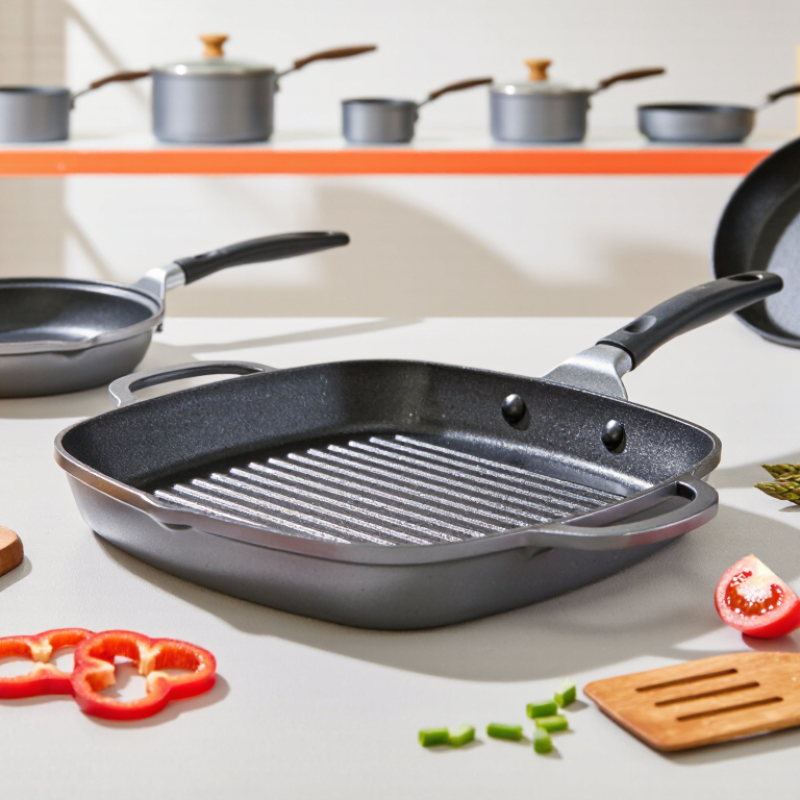
A quality die-cast nonstick grill pan manufacturer proves performance before discussing price. Grand View Research valued the global cookware market at about US$19.7 billion in 2023. This growth increases competition, but not every factory offers equal control. Strong manufacturers use controlled aluminum alloy composition, stable casting pressure, and even base thickness. A pan should heat consistently, without cold corners or visible warping.
Coating discipline matters more. Manufacturers should test adhesion, abrasion resistance, thermal cycling, and food-contact migration through independent laboratories. ISO 2409 provides a recognized method for coating adhesion assessment, while EU food-contact rules require documented compliance. Reliable factories keep batch records, coating thickness data, and traceable raw-material certificates. They also inspect handles, rivets, flatness, and induction compatibility. A glossy sample can mislead. Factory audits reveal more.
Tips: Ask for recent test reports, not marketing claims. Request production samples from different batches. Check the cooking surface under angled light; pinholes and rough ridges often appear there. Review the manufacturer’s defect rate and corrective-action records. A supplier reporting zero defects may sound impressive, but it deserves careful questioning. Real production has variation. The better manufacturer measures it, explains it, and improves it. Industry 4.0 sounds useful, yet manual inspection still catches details that cameras sometimes miss.
How China’s Die-Cast Grill Pan Industry Has Developed
China’s die-cast grill pan industry has moved beyond low-cost production. It now combines aluminum alloy casting, CNC finishing, automated coating, and export-oriented quality control. Grand View Research estimated the global cookware market at about US$19.7 billion in 2022, with growth projected through 2030. This demand encouraged Chinese manufacturers to invest in pressure-casting equipment and improved mold design.
The development is visible in practical details. Thicker bases improve heat stability, while machined surfaces support more even induction contact. Many factories now test coating adhesion, thermal cycling, handle strength, and dimensional tolerance. Food-contact documentation has also become more important for overseas buyers. However, production quality still varies. A polished sample may hide weak coating preparation or inconsistent alloy control. That is why factory evidence matters more than catalog claims.
Tips: Ask for recent test reports, coating specifications, alloy details, and batch traceability. Check whether testing follows recognized food-contact requirements in your target market. The China Foundry Association and national manufacturing statistics indicate continued modernization, but public data rarely separates die-cast grill pans from wider cookware. Buyers should therefore combine market reports with factory audits, sample testing, and small trial orders. Even experienced purchasers can overlook warping after repeated heating. A second inspection is often worthwhile.
China’s Top 10 Die-Cast Nonstick Grill Pan Manufacturers
China’s Top 10 Die-Cast Nonstick Grill Pan Manufacturers are best assessed through engineering, testing, and delivery records. Grand View Research valued the global cookware market at approximately USD 19.9 billion in 2023. It also forecasts steady growth through 2030. That demand supports China’s strong die-casting and finishing capabilities.
Look for manufacturers using controlled aluminum alloy casting, stable wall thickness, and machined base surfaces. A reliable pan should heat evenly across ridges and remain flat after repeated heating cycles. Inspectors should request coating adhesion, abrasion, thermal shock, and food-contact test reports. The ISO 2409 cross-cut method can help assess coating adhesion. Independent laboratory results are more useful than factory claims. Small details matter.
Capacity matters too. The top ten should show traceable batch records, in-process temperature checks, and documented final inspections. IMARC’s cookware market analysis identifies convenience, durability, and healthier cooking as important demand factors. However, market growth does not prove consistent quality. A supplier may pass a sample inspection yet struggle during mass production. That weakness deserves attention. Buyers should compare defect rates, mold maintenance, packaging protection, and replacement policies. An honest ranking remains imperfect because private production data is limited. Past performance is valuable, but it can change after new tooling, staff turnover, or coating suppliers.
China’s Top 10 Die-Cast Nonstick Grill Pan Manufacturers
Manufacturing evaluation framework based on practical buyer priorities rather than company or brand rankings.
The chart presents a 100-point assessment framework for comparing die-cast nonstick grill pan manufacturers in China. Product safety, coating durability, die-casting quality, heat performance, and quality control receive the highest weighting because they directly influence cooking performance, service life, and compliance.
How to Compare Products, Certifications, and Production Capabilities
When comparing China’s top 10 diecast nonstick grill pan manufacturers, inspect products beyond catalog photographs. Check aluminum thickness, pan weight, grill rib height, base flatness, and handle strength. A heavier pan often retains heat better, but weight alone proves little. Test coating adhesion, abrasion resistance, food-contact safety, and heat distribution with documented reports. Ask whether the coating suits gas, electric, or induction cooking.
Certifications need careful verification. Request current ISO 9001 records, food-contact test reports, and applicable FDA or LFGB documentation. Confirm the certificate holder, factory address, testing scope, and expiration date. A certificate may cover one coating or product series only. Do not accept a logo as evidence. Production capability matters equally. Review die-casting equipment, mold maintenance, coating lines, curing temperatures, inspection points, and monthly capacity. Factory audits and traceable batch records reveal more than sales claims.
Tips: Order samples from several suppliers. Measure thickness and weight yourself. Cook acidic food, then inspect discoloration and scratches. Request pre-shipment inspection photos and corrective-action records. A polished factory tour can still hide inconsistent batches. I have found that small details, such as uneven ribs or loose rivets, often appear after repeated use. Allow time for retesting; rushing selection can create expensive problems.
Key Factors for Choosing the Right Chinese Manufacturer
Choosing among China’s top 10 diecast nonstick grill pan manufacturers requires more than comparing online rankings. A reliable supplier should explain its aluminum alloy, casting method, coating layers, and handle attachment process. Ask for material specifications and food-contact test reports. Do not accept vague claims about durability.
Request samples before discussing large orders. Examine the pan’s weight, cooking surface, grill ridges, base flatness, and edge finishing. Heat the pan repeatedly and check for warping, bubbling, or uneven coating. A factory may provide attractive samples, but production quality can change. This happens.
Factory verification also matters. Review production equipment, coating rooms, inspection records, and packaging procedures. Confirm whether quality checks cover coating thickness, dimensions, surface defects, and handle strength. Traceable batch records can make future problems easier to investigate. Independent inspection is worth considering when order quantities are high.
Communication reveals operational maturity. The manufacturer should provide clear answers about tooling costs, minimum order quantities, lead times, replacement policies, and export documents. Confirm technical drawings in writing, including pan dimensions and coating requirements. A low quotation may hide expensive tooling or weak after-sales support. I would also test response speed during a small trial order. Delays at this stage often become larger problems later. Reliable cooperation is built through evidence, not confident promises.
FAQS
Look for controlled aluminum casting, even wall thickness, and a machined flat base. The pan should heat evenly across its ridges. Quality can still vary between batches.
Request coating adhesion, abrasion, thermal shock, and food-contact test reports. The ISO 2409 cross-cut method can assess adhesion. Independent laboratory results are more convincing.
Check its weight, ridges, edges, handle, and base flatness. Heat it repeatedly. Watch for warping, bubbles, or uneven coating.Small defects matter.
Traceable batch records connect materials, temperatures, inspections, and final shipments. They help identify problems later. Without records, investigation becomes guesswork.
No. A factory may produce an excellent sample but struggle with larger orders. Compare production defect rates, inspection records, and replacement policies.That risk is real.
Review casting equipment, coating rooms, inspection areas, and packaging procedures. Confirm checks for coating thickness, dimensions, surface flaws, and handle strength. Photos alone may not be enough.
Confirm tooling costs, minimum order quantities, lead times, export documents, and replacement terms. Record pan dimensions and coating requirements in technical drawings. A low quotation may hide extra costs.
Ask precise technical questions and observe response speed during a small trial order. Clear replies show better operational control. Delays may grow later, though this is not always certain.
Conclusion
China has become a major production base for Diecast Non-Stick Grill Pans, supported by advanced aluminum casting, precision machining, automated coating, and large-scale manufacturing systems. This overview explains what defines a quality manufacturer, including consistent material selection, strong pan construction, uniform heat distribution, durable nonstick performance, reliable inspection procedures, and responsive customization services. It also outlines how the industry has developed from basic cookware production toward more specialized, export-oriented manufacturing.
The selection of China’s top ten manufacturers should focus on measurable capabilities rather than reputation alone. Buyers can compare product design, coating technology, certifications, factory equipment, quality control, production capacity, lead times, packaging support, and compliance with target-market requirements. Choosing the right partner requires evaluating samples, communication, order flexibility, technical expertise, and long-term supply stability. A careful comparison of these factors can help importers and cookware businesses identify a dependable manufacturer that delivers safe, consistent, and market-ready grill pans.

Blog Tags: