
Industry Insights & Manufacturing Blog
Explore expert technical guides, material standards, and global supply chain updates from Prowa Kitchenware Industries.
7 Tips to Choose the Best Aluminum Non Stick Fry Pans?
Table of Contents
- Understand Aluminum Nonstick Fry Pan Materials and Construction
- Compare Coating Types for Safety, Durability, and Easy Release
- Choose the Right Pan Size, Shape, Weight, and Handle Design
- Check Heat Compatibility, Maintenance Needs, and Cooking Performance
- Evaluate Brand Quality, Warranty Coverage, and Overall Value
- FAQS
- Conclusion
- Related Posts
Choosing the right Aluminum Non-Stick Fry Pans is not simply about finding the darkest coating or lowest price. A good pan should heat evenly, release food cleanly, and remain stable after repeated cooking. In a busy kitchen, these details matter. A thin pan may warp over high heat, while a heavy pan can feel tiring during daily use.
Industry research supports this growing focus on performance and durability. Grand View Research’s cookware market analysis identifies non-stick cookware as a major product category, influenced by convenience, healthier cooking preferences, and easier cleaning. The Aluminum Association also explains that aluminum offers strong thermal conductivity and a favorable strength-to-weight ratio. These qualities help explain its popularity in frying pans. However, aluminum alone does not guarantee quality. The construction still matters.
This guide presents seven practical checks for choosing better Aluminum Non-Stick Fry Pans. They include aluminum thickness, coating composition, surface durability, base compatibility, handle design, oven limits, and care requirements. Product claims should be verified through manufacturer specifications, independent testing, and recognized food-contact safety standards. The U.S. Food and Drug Administration provides regulatory guidance for food-contact substances, but compliance language can vary by market. Read the details carefully.
No pan is perfect.
Real cooking exposes weaknesses quickly. Eggs may reveal poor release, while a heavy steak can expose uneven heating. Some recommendations also oversimplify coating performance. Temperature control, utensils, and cleaning habits influence results. The best choice balances measurable specifications with the cook’s actual routine, budget, and cooking surface. A careful comparison can prevent an attractive purchase from becoming an expensive disappointment.
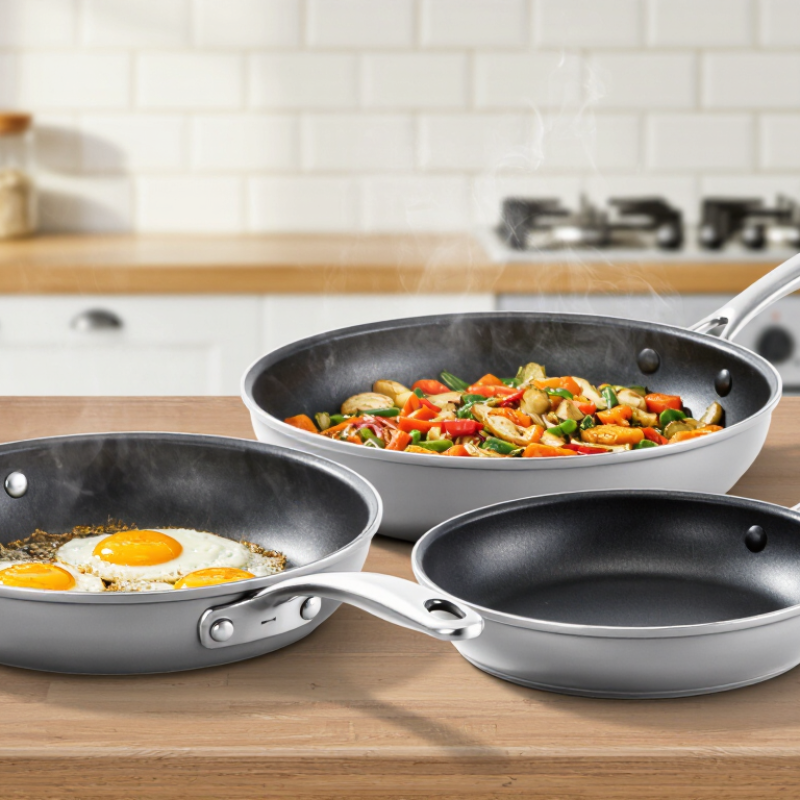
Understand Aluminum Nonstick Fry Pan Materials and Construction
An aluminum nonstick fry pan begins with its core, not its coating. Aluminum spreads heat quickly, but thin metal can develop hot spots above a strong burner.
The U.S. Geological Survey’s Mineral Commodity Summaries 2024 estimated global aluminum smelter production at about 70 million metric tons in 2023. That scale supports aluminum’s importance, but it does not guarantee good cookware.
Look closer. Choose a pan with a visibly thick body, a stable flat base, and even wall construction. A bonded magnetic plate can improve induction compatibility, while a poorly attached plate may warp after repeated heating. I once judged pans by weight alone. That was a poor shortcut.
The nonstick layer also needs careful inspection.
PTFE-based coatings sit over treated aluminum, and their service life depends on surface preparation, coating thickness, heat control, and utensil use. A “PFOA-free” statement describes one chemical concern, not total scratch resistance or lifetime performance.
Ask whether the coating received abrasion, adhesion, and food-contact testing from an independent laboratory. Standards-based documentation is more useful than vague durability claims. Handle attachment matters too; rivets can remain secure, but they may collect residue around the cooking surface.
A fully sealed edge is easier to clean. Check the rim for smoothness, the base for wobble, and the interior for pinholes. Thickness alone can mislead. Heat distribution, coating bonding, and daily ergonomics must work together. Industry guidance often sounds precise, yet home stoves vary widely, so real kitchen testing still deserves attention.
Compare Coating Types for Safety, Durability, and Easy Release
Choosing an aluminum non-stick fry pan starts with its coating, not its shine. Compare PTFE and ceramic sol-gel surfaces for safety, durability, and easy release. PTFE usually offers smoother egg release and better resistance to acidic foods. The German Federal Institute for Risk Assessment states that PTFE coatings are generally safe during normal cooking, but overheating above approximately 360°C can create hazardous decomposition fumes. Never preheat an empty pan for long.
Ceramic coatings are often marketed as PFAS-free and tolerate higher heat, but their release performance may decline faster. A 2023 European Chemicals Agency restriction proposal highlights the environmental persistence of many PFAS, making material disclosure worth checking. Ask whether the ceramic layer is independently tested, not merely advertised as “natural.” Marketing can be vague. Look for coating thickness, abrasion testing, and clear food-contact documentation.
Feel the handle and inspect the rim. A heavy-gauge aluminum body distributes heat more evenly and reduces hot spots. Choose a smooth cooking surface, firmly attached handle, and base suitable for your cooktop. Use medium heat, silicone or wooden utensils, and hand washing when possible. The U.S. Food and Drug Administration requires food-contact materials to meet applicable safety standards, but it does not guarantee endless coating life. No coating is permanent. Even careful users may see wear after repeated stacking, scraping, or dishwasher cycles. Replace the pan when bubbling, peeling, or exposed metal appears.
7 Tips to Choose the Best Aluminum Non-Stick Fry Pans
Compare common aluminum pan surface systems by release performance, abrasion resistance, heat tolerance, and utensil compatibility. Scores use a practical 1–5 scale based on typical material characteristics; actual performance depends on thickness, manufacturing quality, cooking temperature, and care.
How to use this comparison: Choose PTFE when easy release is the priority and cooking temperatures are controlled. Choose ceramic sol-gel when you prefer a PTFE-free surface, while recognizing that release performance can decline faster with overheating and abrasive cleaning. Hard-anodized aluminum offers strong heat and abrasion resistance, but it is not inherently non-stick unless it has an additional release coating.
- Check the coating type and whether it is clearly identified.
- Prefer a thick, stable aluminum body for more even heating.
- Look for a smooth, continuous cooking surface without exposed metal.
- Use low to medium heat for coated non-stick pans.
- Choose pans compatible with your preferred utensils and cooktop.
- Prioritize a comfortable handle and a stable, flat base.
- Follow the care instructions to preserve release performance and durability.
Choose the Right Pan Size, Shape, Weight, and Handle Design
Choosing the right aluminum non-stick fry pan starts with size. An 8-inch pan suits one egg or a small portion. A 10-inch pan provides about 56% more cooking surface than an 8-inch pan. That difference matters when browning vegetables without crowding them. For families, a 12-inch pan handles several portions, but it needs more storage space and a stronger handle.
Shape affects control. A gently sloped wall helps omelets slide out, while a taller wall contains sauces and splattering oil. Aluminum is attractive because its density is about 2.7 g/cm³, compared with approximately 7.8 g/cm³ for steel, according to The Aluminum Association. Still, very thin aluminum can feel unstable and may heat unevenly. Check the base thickness and ask whether it stays flat after repeated heating. It is an easy detail to overlook.
Weight should feel balanced, not merely light. A pan that tilts when lifted can cause spills. The handle should remain cool, offer a firm grip, and connect without visible looseness. EN 12983-1 cookware requirements address handle attachment and safe domestic use, but standards cannot replace your own hand test. Hold the pan with one hand. Does your wrist bend? That answer is useful. Consumer testing reports commonly assess heat distribution, release performance, and handle strength, yet kitchen habits differ. I would not choose a pan from test scores alone; a comfortable 10-inch pan often beats a technically superior pan that feels awkward.
| Tip | Selection Dimension | Recommended Specification | Why It Matters | Practical Buying Check |
|---|---|---|---|---|
| 1 | Choose the Right Pan Diameter | 20–24 cm: 1–2 servings 26–28 cm: 2–4 servings 30–32 cm: 4–6 servings |
A larger cooking surface provides more room for food, but it may heat less evenly on a small burner and can be harder to store. | Match the base diameter to the burner. For everyday home cooking, a 26–28 cm pan is a versatile choice. |
| 2 | Select a Useful Pan Shape | Round, gently sloped sides: general frying and sautéing Straight sides: sauces and larger food portions Wide, flat base: pancakes, eggs, and searing |
Shape affects usable cooking area, food tossing, stirring, and how easily ingredients can be removed with a spatula. | Look for a flat base with smoothly curved edges and enough interior space for the intended recipes. |
| 3 | Balance Weight and Stability | 20–24 cm: approximately 0.6–1.0 kg 26–28 cm: approximately 0.9–1.4 kg 30–32 cm: approximately 1.2–1.8 kg |
Aluminum is naturally lightweight and heats quickly. Additional thickness can improve stability and reduce the risk of warping. | Lift the pan with one hand and test whether the handle keeps the pan level when it is empty. |
| 4 | Check the Aluminum Construction | Cast or forged aluminum: thicker, more rigid body Pressed aluminum: lighter and generally more economical Thick base: preferable for daily use |
A rigid body and stable base help distribute heat more consistently and reduce deformation during repeated heating. | Avoid visibly thin, flexible bases. The pan should sit flat without rocking on a smooth surface. |
| 5 | Evaluate the Non-Stick Coating | Choose a smooth, evenly applied coating with no bubbles, scratches, bare spots, or uneven edges. Multi-layer coatings generally offer better abrasion resistance than basic single-layer coatings. | Coating quality affects food release, cleaning effort, and usable service life. No non-stick coating is completely scratch-proof. | Inspect the interior under bright light. Use silicone, wood, or plastic utensils and avoid metal tools. |
| 6 | Choose the Correct Handle Design | A long, ergonomic handle with a secure connection, heat-resistant grip, and a hanging hole is suitable for stovetop cooking. A helper handle is useful on pans 28 cm and larger. | A balanced handle improves control and reduces the chance of tipping, especially when the pan contains hot food. | Check that the handle does not become excessively hot during normal stovetop use and that its attachment has no looseness. |
| 7 | Confirm Cooktop and Care Compatibility | Standard aluminum pans work well on gas, electric, and ceramic cooktops. Induction requires a magnetic stainless-steel base or another induction-compatible construction. | Aluminum itself is not magnetic, so an unmodified aluminum pan will not heat on an induction cooktop. | Verify the cookware symbol and care instructions. Hand washing, moderate heat, and avoiding thermal shock can help preserve the coating. |
Check Heat Compatibility, Maintenance Needs, and Cooking Performance
7 Tips to Choose the Best Aluminum Non Stick Fry Pans
Check the base material before judging the coating. The Aluminum Association reports aluminum conductivity near 205 W/m·K, helping heat spread quickly. Look for a thick, flat base. Thin pans may heat fast but warp over high heat. Test the handle. It should stay stable when the pan holds food. Check heat compatibility with your stove, especially induction. Aluminum alone usually needs a magnetic steel layer for induction cooking.
Inspect the coating for an even, smooth surface. Small bubbles or rough patches can become weak points. Choose a pan with clear temperature guidance. The German Federal Institute for Risk Assessment warns that overheated PTFE coatings can decompose around 360°C. Never preheat an empty pan for long. Medium heat is usually enough for eggs, fish, and pancakes. I once used high heat for faster browning. The result was uneven cooking, not better flavor.
Review maintenance needs before buying. Hand washing with a soft sponge often protects the coating longer than abrasive cleaning. Avoid metal utensils unless the manufacturer permits them. Check whether the pan is dishwasher-safe, but remember that safe does not mean gentle. Test cooking performance with one teaspoon of oil and a cold egg. Observe sticking, edge browning, and heat recovery after adding food. This test is imperfect. Still, it exposes weak heat control quickly. Consult the product’s care instructions and relevant safety guidance before regular use.
Evaluate Brand Quality, Warranty Coverage, and Overall Value
Choosing the best aluminum nonstick fry pan requires more than comparing prices. A reliable manufacturer should explain the pan’s aluminum grade, coating construction, and testing process. Look for a flat base, even walls, and a handle that feels firm after repeated lifting. Product instructions should clearly state suitable temperatures, utensils, and cleaning methods. Vague claims deserve caution.
In my kitchen, I test a pan with eggs, vegetables, and a small amount of oil. The surface should release food evenly, without hot spots near the center. I also inspect the handle rivets and edges after several washes. These details reveal manufacturing quality. A polished appearance is not enough. Some attractive pans lose performance quickly.
Warranty coverage can show how seriously a company supports its product. Check the coverage period, proof-of-purchase rules, and exclusions for overheating or metal utensils. A useful warranty should explain replacement procedures in plain language. Customer service response time matters, too. Keep the receipt and product details.
Overall value depends on lifespan, cooking results, care demands, and replacement support. A cheaper pan may cost more if its coating fails within months. I once focused too heavily on the lowest price. That was a mistake. Still, a premium price does not guarantee better performance. Compare coating durability, heat control, warranty protection, and everyday comfort before choosing.
FAQS
PTFE usually releases eggs, fish, and pancakes more smoothly. Ceramic coatings may feel natural, but release performance can decline sooner. Neither coating lasts forever.
They are generally safe when used at normal temperatures. Avoid overheating above about 360°C. Never leave an empty pan over high heat.
Ceramic coatings often tolerate higher heat. However, their surface may lose slipperiness faster. Check independent testing, not vague “natural” claims.
Look for coating thickness, abrasion testing, and food-contact documentation. Avoid surfaces with bubbles or rough patches. Small flaws can become weak points.
An 8-inch pan suits one egg or a small portion. A 10-inch pan offers about 56% more cooking space. A 12-inch pan works better for family portions.
It should feel balanced, not simply light. A tilting pan can spill food. Hold it with one hand and check whether your wrist bends.
Choose a firmly attached handle with a comfortable grip. The base should be thick and flat. Aluminum usually needs a magnetic steel layer for induction cooktops.
Use medium heat and silicone or wooden utensils. Wash by hand with a soft sponge when possible. Dishwasher cleaning is convenient, but not always gentle.
Add one teaspoon of oil to a cold pan. Cook one egg and observe sticking, browning, and heat recovery. The test is imperfect, but useful.
Replace it when bubbling, peeling, or exposed metal appears. Repeated stacking and scraping can accelerate wear. I used high heat once; cooking became uneven, not better.
Conclusion
Choosing the best Aluminum Non-Stick Fry Pans starts with understanding their material and construction. Look for a well-balanced aluminum body that heats evenly without feeling excessively heavy. Compare coating types based on safety, durability, food release, and resistance to everyday wear. Select a size and shape that match your cooking habits, while also considering the pan’s weight, handle comfort, grip, and storage convenience.
Before buying, confirm that the pan suits your stovetop and intended cooking temperatures. Consider whether it can be used in an oven and how easy it is to clean and maintain. A quality pan should deliver consistent heating, smooth cooking performance, and reliable results with minimal oil. Finally, evaluate the manufacturer’s quality standards, warranty coverage, customer support, and overall value rather than focusing only on the initial price. By balancing construction, coating, design, compatibility, care requirements, and long-term reliability, you can choose Aluminum Non-Stick Fry Pans that fit your kitchen and daily cooking needs.

Blog Tags: