
Industry Insights & Manufacturing Blog
Explore expert technical guides, material standards, and global supply chain updates from Prowa Kitchenware Industries.
China Top 10 Stainless Steel Serving Tongs Suppliers
Table of Contents
- Stainless Steel Serving Tongs: Definition, Uses, and Key Features
- How to Evaluate Chinese Stainless Steel Serving Tongs Suppliers
- China’s Top 10 Stainless Steel Serving Tongs Suppliers
- Supplier Comparison: Materials, Customization, Quality, and Pricing
- How to Select the Right Chinese Serving Tongs Supplier for Your Needs
- FAQS
- Conclusion
- Related Posts
Choosing reliable suppliers requires more than comparing catalog prices. Stainless Steel Serving Tongs must perform through buffets, restaurant kitchens, catering events, and repeated washing. Their quality appears in small details: smooth hinge movement, balanced spring tension, secure scalloped tips, and handles that remain comfortable after long service.
Chef Thomas Keller once said, “Respect for food is a respect for life, for who we are and what we do.” That principle also applies to serving equipment. Well-designed tongs protect food presentation, reduce unnecessary contact, and help staff work with greater control. For buyers, material claims deserve careful attention. Grade 304 stainless steel, often described as 18/8 or 18/10, usually offers dependable corrosion resistance. However, supplier descriptions can be incomplete. Request material reports, product drawings, factory photographs, and sample inspections before making a large order.
This guide examines China’s top Stainless Steel Serving Tongs suppliers through practical purchasing criteria. It considers manufacturing experience, customization capacity, quality-control procedures, export communication, packaging, and after-sales support. A strong supplier should explain its polishing process and disclose tolerances honestly. It should also test hinges, welds, and surface finishing, not only inspect appearance.
No ranking is flawless. Buyer priorities differ. A hotel may need 12-inch tongs with hanging loops, while a bakery may prefer compact models with silicone tips. Some suppliers look impressive online but respond slowly when samples reveal problems. That matters. The following overview aims to separate polished marketing from dependable production evidence, while recognizing that even careful evaluations may need revision as factories, certifications, and product lines change.
Stainless Steel Serving Tongs: Definition, Uses, and Key Features
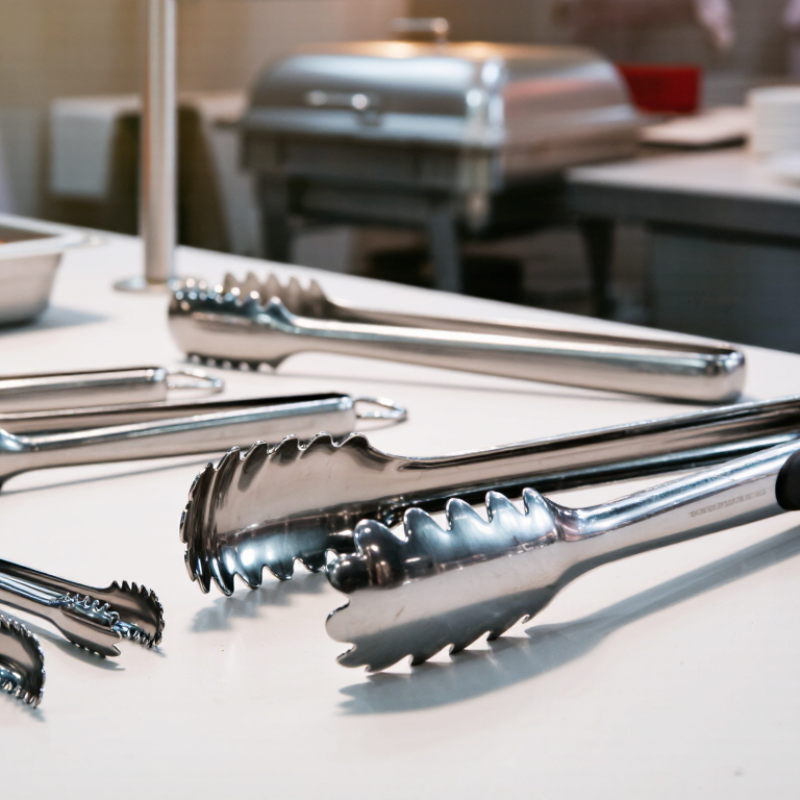
Stainless steel serving tongs are hand-operated utensils used to lift, turn, and portion food. They usually have two connected arms and spoon-shaped, scalloped, or flat gripping ends. Stainless steel gives them strength, corrosion resistance, and a clean appearance. Food-service buyers often choose 18/8 or 18/10 steel for better durability and surface stability. However, steel grade alone does not guarantee quality.
In restaurant kitchens, these tongs handle vegetables, noodles, meat slices, pastries, and buffet dishes. Their length should match the task. Short tongs offer control, while longer models protect hands from heat and crowded serving trays. A locking ring can save drawer space. Some users prefer silicone-tipped ends for delicate cookware, but plain steel grips usually provide firmer control. During product inspections, check the hinge first. It should open smoothly and resist side-to-side movement. Rough edges, weak springs, or uneven jaws can affect hygiene and handling. I once overlooked a slightly stiff hinge, and repeated use made it worse. That small detail changed the evaluation. Suppliers in China may offer custom lengths, stamped logos, packaging options, and sample testing. Ask for material documentation, load testing, polishing standards, and cleaning guidance. Inspect the joint after washing, not only when the product looks new. Availability matters too. Consistent production and clear communication support reliable purchasing.
Stainless Steel Serving Tongs: Definition, Uses, and Key Features
Stainless steel serving tongs are hinged utensils designed to grip, lift, and portion food. They are commonly used for salads, buffet dishes, pasta, bread, ice, barbecue foods, and other shared foods.
The chart shows representative midpoint values from commonly specified stainless steel composition ranges. Actual chemistry may vary by applicable ASTM or EN product standard.
304 Stainless Steel
Widely used for food-contact utensils because of its corrosion resistance, clean appearance, durability, and ease of fabrication.
316 Stainless Steel
Contains molybdenum, providing enhanced resistance to chlorides and salty environments. It is suitable for demanding commercial or coastal applications.
430 Stainless Steel
A ferritic stainless steel that offers good oxidation resistance, magnetic properties, and cost efficiency for general serving applications.
How to Evaluate Chinese Stainless Steel Serving Tongs Suppliers
When evaluating Chinese stainless steel serving tongs suppliers, begin with material evidence, not catalog photos. The International Stainless Steel Forum reported about 58.4 million tonnes of global crude stainless steel production in 2023. China produced roughly 36.7 million tonnes. This scale supports competitive sourcing, but it does not guarantee suitable kitchenware.
Ask for mill test certificates, grade confirmation, and batch traceability. For food-contact tongs, 304 stainless steel is common, while 316 may suit higher-salt environments. Verify this with PMI testing or an independent laboratory. Also check jaw alignment, spring recovery, weld finishing, edge smoothness, and corrosion resistance. Small details matter.
Request production samples from different lots. Measure handle thickness and opening force. Test repeated operation, dishwasher exposure, and packaging strength. A supplier should provide clear tolerances and corrective-action records. ISO’s 2023 Survey reported more than 1.2 million ISO 9001 certificates worldwide, yet certification alone cannot prove product quality. It only shows that a management system exists. This is an easy mistake.
Review factory capacity, subcontracting controls, inspection staffing, minimum order quantities, and realistic lead times. Confirm whether the quoted price includes polishing, testing, packaging, and export documents. Independent audits can reveal crowded storage areas or weak traceability. Remote assessments help, but they miss uncomfortable details. A first order should remain limited. Reliability is demonstrated through repeated batches, not confident promises.
China’s Top 10 Stainless Steel Serving Tongs Suppliers
China’s Top 10 Stainless Steel Serving Tongs Suppliers should be assessed through evidence, not catalog photography.
World Stainless reported approximately 58.4 million tonnes of global crude stainless steel production in 2023. China contributed about 36.7 million tonnes, showing its strong manufacturing depth. This scale supports competitive sourcing, but it does not guarantee consistent serving tong quality.
A practical top-ten shortlist should examine stainless grade, thickness, jaw alignment, spring recovery, and polishing quality.
Food-contact models commonly use 18/8 or 18/10 stainless steel, while harsher kitchen environments may require higher corrosion resistance. Suppliers should provide material certificates, production samples, and inspection records. ISO 9227 salt-spray testing can reveal corrosion weaknesses, although it does not fully represent daily washing conditions. That limitation matters.
Industry reports from Grand View Research identify foodservice equipment as a growing global market, driven by restaurants, catering, and institutional kitchens. Demand is becoming more specification-led. Strong Chinese suppliers usually offer laser welding, automatic polishing, batch traceability, and packaging that prevents scratches.
Ask for cycle testing, too. A tong may look precise but lose tension after repeated opening. I have seen this gap in supplier evaluations.
Price comparisons can also mislead when steel thickness, handle finishing, and inspection coverage differ. The best purchasing decision combines factory audits, independent testing, and small pilot orders before larger volume commitments.
Supplier Comparison: Materials, Customization, Quality, and Pricing
When comparing China’s top ten stainless steel serving tong suppliers, material selection deserves close attention. Most offer 304 stainless steel for stronger corrosion resistance and safer food contact. Some quote 201 stainless steel, which can reduce cost but may stain sooner in humid kitchens. Ask for the steel grade, thickness, and surface treatment in writing. A smooth satin finish hides fewer polishing defects than a mirror finish. Small details matter.
Customization ranges from handle shape to laser-etched logos, packaging, and color sleeves. Experienced suppliers usually provide drawings, samples, and mold details before mass production. Check jaw alignment by closing the tongs on a flat card. Uneven pressure suggests weak forming control. A simple cycle test also helps. Open and close each sample repeatedly. The spring may feel fine at first, then lose tension.
Pricing should be compared by the full landed cost, not unit price alone. Include minimum order quantity, sample fees, tooling, packaging, inspection, and shipping terms. A cheaper quote may use thinner metal or exclude polishing. Request at least three samples from different production batches. One comparison weakness is trusting certificates without checking the actual product. Documents support reliability, but physical inspection reveals burrs, loose joints, and inconsistent weight. A perfect spreadsheet still misses practical handling.
How to Select the Right Chinese Serving Tongs Supplier for Your Needs
Choosing from China’s top stainless steel serving tongs suppliers requires more than comparing prices and catalog photos. World Stainless reported global stainless crude steel production at about 58.4 million tonnes in 2023. This scale supports strong manufacturing capacity, but it does not guarantee consistent tong quality. Ask each supplier for the steel grade, material certificate, thickness, and production batch records. A polished surface can still conceal weak joints.
Request samples before discussing large orders. Test the tongs with oily food, hot water, and repeated opening cycles. Check whether the arms remain aligned after 500 to 1,000 movements. Inspect the hinge closely; rough edges can collect residue and hurt workers during packing. I would also measure grip strength with the actual food size, not an empty sample. That small detail is often missed.
A reliable supplier should explain inspection points, defect limits, packaging protection, and replacement procedures in writing. ISO’s 2023 Survey lists more than one million ISO 9001 certificates worldwide, yet certification alone proves limited practical performance. Review recent audit records and request independent testing when food-contact claims matter. Confirm traceability from steel purchase to final packing.
Delivery history deserves equal attention: compare promised lead time with documented shipment records. Lower prices may reflect thinner material, weaker springs, or unstable polishing. My own selection mistake would be trusting a perfect sample without testing the second production batch. Ask difficult questions early. Supplier transparency is measurable.
FAQS
Request material certificates, grade confirmation, and batch traceability records. Do not rely on catalog photographs alone. Evidence matters more.
304 stainless steel is common for food-contact tongs. Higher-salt environments may require 316 stainless steel. Confirm the grade independently.
Use material certificates, PMI testing, or an independent laboratory. Compare test results with the supplier’s stated grade. Mistakes happen.
Inspect jaw alignment, spring recovery, weld finishing, edge smoothness, and handle thickness. Uneven jaws may grip food poorly.
Different lots can reveal inconsistent materials or finishing. Test repeated opening, dishwasher exposure, corrosion resistance, and packaging strength.
No. Certification usually shows that a management system exists. It does not prove every tong meets your requirements. This is often overlooked.
Review production capacity, inspection staffing, subcontracting controls, minimum order quantities, and realistic lead times. Confirm who performs final checks.
Ask whether polishing, testing, packaging, and export documents are included. A low quote may exclude important quality steps.
Remote assessments are useful, but they may miss crowded storage or weak traceability. An independent audit can reveal uncomfortable details.
Keep the first order limited and use a pilot batch. Measure quality across repeated deliveries. Confident promises are not proof.
Conclusion
This guide explores Stainless Steel Serving Tongs, including their definition, common uses, and essential features such as corrosion resistance, food safety, ergonomic handles, secure gripping, and easy cleaning. It explains why these tongs are widely used in restaurants, catering operations, hotels, households, and foodservice environments for handling salads, cooked foods, baked goods, and buffet dishes. The article also introduces practical methods for evaluating Chinese suppliers, including manufacturing experience, material standards, production capacity, quality control, certifications, communication, and delivery reliability.
A detailed comparison of China’s top 10 Stainless Steel Serving Tongs suppliers focuses on material options, product design, customization capabilities, packaging, quality consistency, minimum order quantities, and pricing. The final section provides guidance for selecting the right supplier according to application, budget, order volume, branding requirements, and expected service life. By reviewing these factors systematically, buyers can reduce sourcing risks and establish a dependable supply relationship.

Blog Tags: