
Industry Insights & Manufacturing Blog
Explore expert technical guides, material standards, and global supply chain updates from Prowa Kitchenware Industries.
Best Stainless Steel Cutlery Sets from China Wholesale
Table of Contents
- Stainless Steel Cutlery Sets: Materials, Grades, and Essential Components
- Manufacturing Standards and Quality Control in Chinese Cutlery Production
- Key Features of the Best Wholesale Cutlery Sets from China
- How to Evaluate Suppliers, Pricing, and Minimum Order Quantities
- Importing, Customization, Packaging, and Compliance Requirements
- FAQS
- Conclusion
- Related Posts
China’s wholesale market offers a wide range of Stainless Steel Cutlery Sets for hotels, restaurants, retailers, and hospitality suppliers. The opportunity is substantial, but product selection requires more than comparing prices.
The International Stainless Steel Forum reported global crude stainless steel production of about 62.2 million tonnes in 2024. This reflects strong material demand across construction, food service, and consumer goods. Market research from Grand View Research also indicates continued growth in the global stainless steel cutlery sector, although estimates differ by product scope and regional coverage. That variation deserves attention.
Material grade matters. 18/10 stainless steel generally provides stronger corrosion resistance and a brighter finish than lower-nickel alternatives. Grade 430 can reduce costs, but it may offer less resistance in humid kitchen environments. Buyers should examine spoon thickness, fork balance, knife hardness, polishing quality, and weld consistency. A shiny sample can still hide weak edges or uneven weight.
Materials scientist Michael F. Ashby wrote, “Materials are the stuff of design.” His principle applies directly to cutlery. Steel composition affects durability, appearance, maintenance, and customer experience.
Chinese manufacturers can support custom logos, mirror or satin polishing, gift packaging, and flexible production volumes. Yet factory audits, sample testing, and clear inspection standards remain essential. I have seen attractive catalogs create unrealistic expectations. A lower quotation may reflect thinner metal, simpler polishing, or weaker packaging.
This guide evaluates the Best Stainless Steel Cutlery Sets from China Wholesale through practical purchasing criteria, verified specifications, and long-term value. Small details matter. Fancy photos do not replace dependable performance.
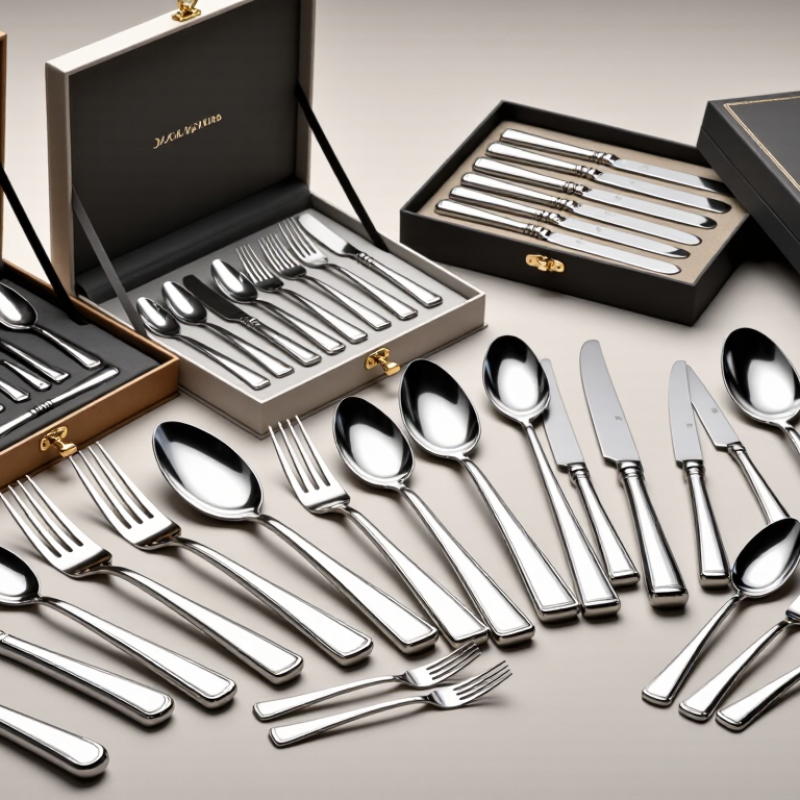
Stainless Steel Cutlery Sets: Materials, Grades, and Essential Components
Choosing the best stainless steel cutlery sets from China wholesale begins with understanding the metal, not the appearance. Grade 304, often marked 18/8 or 18/10, offers strong corrosion resistance and a smooth surface. Grade 430 contains chromium but little or no nickel, making it more magnetic and cost-efficient. Grade 201 can reduce prices, yet it may show stains sooner in humid kitchens. Always request material certificates and test samples.
A complete set should match its intended use. Common components include dinner knives, forks, tablespoons, teaspoons, and serving pieces. Check the knife edge, spoon depth, fork alignment, and handle connection. A well-made handle should feel balanced, with no sharp seam or visible weld. Examine the finish under bright light. Mirror polishing looks refined, while satin finishing hides small scratches better. Small details matter.
From practical quality checks, thickness often affects comfort more than shoppers expect. Very light pieces may bend during daily service. However, heavier is not automatically better. Compare weight, balance, and production consistency across several samples. Ask the supplier about polishing methods, washing tests, packing protection, and carton strength. I have seen attractive samples fail because bulk pieces had uneven surfaces. That mistake is easy to miss without random inspection. Specifications should cover grade, thickness, dimensions, components, and acceptable defects. Reliable records make wholesale purchasing safer.
Manufacturing Standards and Quality Control in Chinese Cutlery Production
Chinese cutlery production depends on controlled materials, stable forming, and repeatable inspection. The World Stainless Association reported 58.4 million tonnes of global stainless steel production in 2023. This scale supports strong supply networks, but volume does not guarantee quality. Wholesale buyers should request material certificates and verify grade composition with handheld X-ray fluorescence testing. Common grades include 304 and 430 stainless steel, yet their nickel content and corrosion resistance differ significantly.
Manufacturers should align testing with ISO 8442 requirements for domestic cutlery, including corrosion resistance, mechanical performance, and edge safety. China’s GB/T 15067.2 standard also provides technical requirements for table cutlery. Factory quality control should cover stamping accuracy, handle attachment, polishing consistency, and washing durability. Inspectors can use salt-spray or dishwasher-cycle testing, although these tests do not perfectly reproduce every household environment. A bright mirror finish may hide weak welds. That detail is easy to miss.
Tips: Ask for pre-production samples, not only finished samples. Check several pieces from different cartons. Request batch records, hardness results, and food-contact safety documentation. Measure blade thickness and handle alignment with simple gauges. Photos help, but physical inspection is more reliable. I have found that suppliers often present their best sample first; repeatability deserves equal attention. Defects may appear only after repeated washing, so a small pilot order can reveal more than a persuasive catalogue.
Key Features of the Best Wholesale Cutlery Sets from China
Best Stainless Steel Cutlery Sets from China Wholesale
The best wholesale cutlery sets from China begin with verified stainless steel quality. Many buyers choose 304 stainless steel for its corrosion resistance and stable performance. For demanding food-service environments, 316 stainless steel may offer stronger resistance to salt and moisture. Always request material test reports. Numbers alone are not enough.
Thickness affects both durability and handling. A well-made dinner fork should feel balanced, not hollow or unusually light. Spoon bowls need smooth edges and consistent depth. Knife blades should cut cleanly without rough grinding marks. Check the welds, polishing lines, and surface finish under bright light. Small flaws become expensive at large order volumes.
A mirror finish looks elegant. It also shows fingerprints quickly. A satin finish may be easier to maintain in busy restaurants. Wholesale packaging should protect each set from scratches during long-distance shipping. Inner sleeves, separators, and strong cartons matter. Ask about sample approval, production inspections, and replacement procedures before placing a bulk order. Custom logos and gift boxes can improve presentation, but they may increase lead time and minimum quantities. No supplier is perfect. Some samples look excellent while later batches vary slightly, so inspection remains necessary. Availability, price, and quality often require compromise. Good purchasing decisions come from checking the details, not trusting attractive photos.
How to Evaluate Suppliers, Pricing, and Minimum Order Quantities
Choosing a stainless steel cutlery supplier in China requires more than comparing catalog photos. Ask for the steel grade, product thickness, polishing method, and food-contact test documents. For everyday tableware, 304 stainless steel is common, while 316 may suit harsher environments. The specification should match actual use. Request a pre-production sample. Check its weight, fork alignment, edge smoothness, mirror finish, and packaging by hand. Small defects often appear after bulk production.
Supplier pricing should be separated into unit cost, tooling, packaging, inspection, freight, and customs-related charges. A low quotation can hide thin steel, weaker packaging, or a higher shipping cost. Ask whether prices are based on EXW, FOB, or another delivery term. Get it written. Compare landed costs, not only factory prices. Minimum order quantities also need careful review. Some suppliers accept 500 sets for standard designs but require several thousand for custom handles or gift boxes. Negotiate a mixed-color or mixed-size trial order when possible.
In my supplier checks, clear answers usually matter more than polished sales language. I ask for recent production photos, quality records, and a realistic lead-time plan. A factory visit or live video inspection can reveal storage conditions and finishing equipment. I once focused too heavily on the lowest MOQ and overlooked carton strength. That mistake cost more during transit. Allow time for sample approval, random inspection, and corrective action before placing a larger order.
Best Stainless Steel Cutlery Sets from China Wholesale - How to Evaluate Suppliers, Pricing, and Minimum Order Quantities
The figures below are practical wholesale reference ranges for China-origin stainless steel cutlery. Prices are indicative EXW estimates in USD per set or piece and can change with steel grade, weight, finish, packaging, testing, customization, order volume, and shipping terms.
| Category | Evaluation Dimension | Typical Wholesale Benchmark | What to Verify with the Supplier | Buyer Decision Guidance |
|---|---|---|---|---|
| Material | Stainless steel grade | 18/0 approximately 18% chromium and no intentional nickel; 18/8 or 18/10 contains chromium and nickel and generally offers better corrosion resistance. | Request the material specification, mill certificate or third-party composition test. Confirm that the declared grade applies to the blades, handles, and all components. | Choose 18/0 for cost-sensitive projects and magnetic compatibility. Choose 18/8 or 18/10 for premium table settings and improved resistance to staining and corrosion. |
| Material | Common steel standards | AISI 430 is commonly associated with 18/0 stainless steel, while AISI 304 is commonly associated with 18/8 or 18/10 stainless steel. | Check whether the supplier uses a recognized material designation and whether the test report identifies the actual finished product rather than only a raw-material sample. | Do not rely only on “food grade” wording. Require a grade-specific document and a sample inspection. |
| Construction | Fork, spoon, and knife thickness | Everyday cutlery commonly uses approximately 1.5–2.5 mm material thickness. Heavyweight and forged products may be thicker and substantially heavier. | Ask for measured thickness at defined points, individual piece weight, dimensional drawings, and tolerance limits. | Compare weight and balance, not only the listed thickness. A heavier set usually has a more substantial feel but may increase freight cost. |
| Construction | Knife manufacturing method | Stamped knives are generally lower-cost. Forged knives typically have a thicker profile, stronger visual presence, and higher production cost. | Confirm whether the knife is stamped or forged, whether the blade is hardened, and how the handle-to-blade connection is constructed. | Use stamped knives for economy programs and forged knives for hospitality, gift, and premium retail collections. |
| Finish | Surface treatment | Mirror polish is glossy; satin or matte polish is less reflective. PVD colors such as gold, black, and champagne add a decorative coating and additional processing. | Request finish samples, coating thickness or adhesion information where applicable, dishwasher-cycle test results, and the approved color standard. | Mirror and satin finishes are usually easier to source consistently. Colored PVD finishes require stricter batch approval and scratch testing. |
| Pricing | Basic 16-piece set | Approximately US$3.00–8.00 per set for standard stainless steel, basic finish, simple packaging, and larger wholesale quantities. | Confirm the number of pieces, steel grade, total set weight, packaging, carton quantity, and whether the quotation is EXW, FOB, or another trade term. | Use the complete landed-cost calculation rather than comparing the unit quote alone. |
| Pricing | Basic 24-piece set | Approximately US$5.00–14.00 per set for standard 18/0 or 18/8 configurations with conventional polishing and retail-ready packaging. | Verify whether serving pieces are included and whether the price includes gift boxes, inserts, barcodes, inner cartons, and export cartons. | Compare the price on a per-piece basis and adjust for the actual metal weight and packaging specification. |
| Pricing | Premium 24-piece set | Approximately US$12.00–30.00+ per set for 18/8 or 18/10 steel, heavyweight construction, forged knives, special finishes, or upgraded packaging. | Request a cost breakdown for steel grade, weight, forging, PVD or other surface treatment, packaging, and quality-control requirements. | Premium pricing should be supported by measurable specifications, approved samples, and documented inspection criteria. |
| Pricing | Individual cutlery pieces | Standard wholesale pieces often range from approximately US$0.20–1.20 each; heavyweight, forged, colored, or specially designed pieces may cost more. | Obtain separate prices for dinner knives, forks, tablespoons, teaspoons, serving utensils, and replacement pieces. | Individual-piece purchasing can reduce unnecessary inventory when customers require mixed assortments. |
| MOQ | Stock or standard design | Common minimums range from approximately 100–500 sets or 500–2,000 pieces, depending on the supplier and available inventory. | Confirm available colors, patterns, packaging, and whether the quoted MOQ applies per design, per finish, or per shipment. | Standard designs are usually the best option for testing demand with limited inventory risk. |
| MOQ | Custom logo or packaging | A practical starting range is approximately 500–2,000 sets, although packaging suppliers may impose separate minimum quantities. | Ask for artwork requirements, plate or mold charges, color limits, proofing fees, packaging MOQ, and re-order conditions. | Separate product MOQ from packaging MOQ to avoid unexpected unused packaging inventory. |
| MOQ | Custom tooling or new shape | Often approximately 2,000–10,000+ sets, plus one-time tooling or development charges. | Request ownership terms for molds, prototype fees, development lead time, revision limits, and the tooling storage policy. | Use custom tooling only when projected volume justifies the development cost and longer lead time. |
| Supplier | Factory capability | A capable supplier should be able to provide consistent samples, production specifications, inspection records, and traceable packing information. | Review production-line photographs or audit records, equipment information, quality procedures, monthly capacity, and subcontracting disclosure. | Prioritize documented process control over catalog size or the lowest initial quotation. |
| Supplier | Quality-control process | Key controls include incoming material verification, dimensional checks, polishing inspection, coating inspection, functional checks, and final random inspection. | Ask for the inspection standard, acceptable quality limit, sampling plan, defect photographs, corrective-action process, and pre-shipment inspection option. | Put measurable acceptance criteria in the purchase contract before mass production begins. |
| Compliance | Food-contact documentation | Requirements depend on the destination market. Documentation may include material declarations, migration or food-contact test reports, and applicable regulatory conformity records. | Specify the destination country and ask for current reports covering the exact material, finish, and product configuration. | A generic certificate may not cover colored coatings, handles, adhesives, or mixed-material components. |
| Logistics | Production lead time | Standard repeat orders commonly require approximately 20–45 days after approval and deposit. Custom designs, tooling, or peak-season orders may require longer. | Confirm sample lead time, production lead time, inspection time, packing time, and the date from which the lead-time clock starts. | Build in time for sample approval, corrective action, export documentation, and transportation. |
| Logistics | Packaging and carton efficiency | Packaging can materially affect damage rates, cubic volume, and freight cost. Retail gift boxes generally cost more and occupy more space than bulk packing. | Request carton dimensions, gross and net weight, pieces per carton, drop-test requirements, inner protection, and palletization details. | Optimize packaging for the sales channel while protecting polished surfaces and sharp knife edges. |
| Commercial Terms | Quotation comparison | A meaningful comparison should use the same steel grade, piece count, weight, finish, packaging, quantity, trade term, and inspection scope. | Request a line-item quotation and identify exclusions such as tooling, artwork, testing, local charges, freight, duties, and taxes. | Select the supplier with the best verified total cost and specification fit, not necessarily the lowest unit price. |
Importing, Customization, Packaging, and Compliance Requirements
Best Stainless Steel Cutlery Sets from China Wholesale
Importing cutlery requires more than comparing factory prices. UN Comtrade trade data places China among the leading exporters under HS 8215, but shipment quality still varies. Ask for stainless grade, thickness, weight, and polishing details. Common options include 18/10 and 18/0 steel. Request mill certificates and laboratory reports before approving samples. A 2023 World Stainless Association report recorded global crude stainless steel production at about 58.4 million tonnes. That scale supports competitive sourcing, yet it does not guarantee food-contact safety.
Customization should cover handle shape, mirror or satin finish, logo method, and set composition. Laser marking may suit premium orders, while deep embossing can improve durability. Packaging needs clear separation between polished surfaces. Use food-safe inner bags, strong export cartons, and moisture protection for sea freight. Specify carton dimensions, gross weight, drop-test expectations, and barcode placement. I have seen attractive samples arrive with scratched spoons because dividers were too thin. Packaging is easy to underestimate.
Tips: Confirm HS code 8215 with your customs broker. Require pre-shipment inspection and retained samples. Check applicable rules, including EU Regulation 1935/2004, FDA food-contact requirements, or national standards. ISO 8442-1 can guide cutlery performance testing. Also review migration, corrosion, and dishwasher-resistance results. Do not accept “food grade” as sufficient evidence. The paperwork should match the actual alloy. Small inconsistencies deserve questions.
Best Stainless Steel Cutlery Sets from China Wholesale
Importing, Customization, Packaging, and Compliance Requirements
The chart compares representative nominal chromium, nickel, and molybdenum content for common stainless steel grades used in cutlery. Grade 304 is widely known as 18/8 stainless steel, grade 316 adds molybdenum for enhanced corrosion resistance, and grade 430 is a nickel-free ferritic option. Actual chemical ranges depend on the applicable specification, such as ASTM A240 or EN 10088. Importers should confirm material certificates, food-contact compliance, labeling, packaging durability, and destination-market requirements before placing a wholesale order.
FAQS
Grade 304, often marked 18/8 or 18/10, resists corrosion well. Grade 430 contains little or no nickel and is usually magnetic. Grade 201 costs less but may stain sooner in humid kitchens.
Request material certificates and test samples before placing a large order. Do not rely only on catalog descriptions. Test the actual pieces.
Typical sets include dinner knives, forks, tablespoons, teaspoons, and serving pieces. Match the components to the intended dining service. Extra pieces may increase cost unnecessarily.
Check the knife edge, spoon depth, fork alignment, and handle connection. Handles should feel balanced and free from sharp seams. Inspect the surface under bright light.
Not necessarily. Very light pieces may bend during daily use. Heavy pieces can still feel awkward or poorly balanced. Compare weight, balance, and consistency across several samples.
Mirror polishing creates a bright, refined surface. Satin finishing hides small scratches more effectively. Choose according to appearance, maintenance, and expected handling.
Separate unit cost, tooling, packaging, inspection, freight, and customs-related charges. Ask whether the quotation uses EXW, FOB, or another delivery term. Compare the landed cost.
Standard designs may accept smaller trial orders than custom handles or gift boxes. Ask about mixed-size or mixed-color trial orders. Approve samples before scaling up.A supplier’s lowest minimum order is not always the safest choice. I once overlooked carton strength. Transit damage followed. Request random inspections, production photos, quality records, and a realistic lead-time plan.
Conclusion
Stainless Steel Cutlery Sets from China wholesale offer a practical combination of durability, design flexibility, and cost efficiency for restaurants, retailers, and hospitality businesses. This guide explains how materials and steel grades affect corrosion resistance, strength, appearance, and long-term performance, while also outlining the essential components commonly included in a complete set. It highlights important manufacturing standards, production controls, polishing methods, finishing consistency, and inspection procedures that help ensure reliable quality.
The article also examines the key features of high-quality wholesale cutlery, including balanced weight, comfortable ergonomics, smooth edges, and consistent workmanship. Buyers will learn how to compare suppliers, pricing structures, minimum order quantities, sample policies, and production capabilities. It further covers customization options, branding-free packaging choices, shipping preparation, product documentation, and general compliance considerations, helping importers plan orders efficiently and select suitable products for their target markets.

Blog Tags: